Enterprise Implementation
How AI-Transcript is deployed, scaled, and integrated within corporate infrastructure
AI transcription at enterprise level is not just a feature - it is an infrastructure decision.
Our approach is designed for large organizations that require:
- Full control over data
- Seamless integration with existing systems
- Scalable processing across teams and regions
This is achieved through a modular architecture deployed within your own environment.
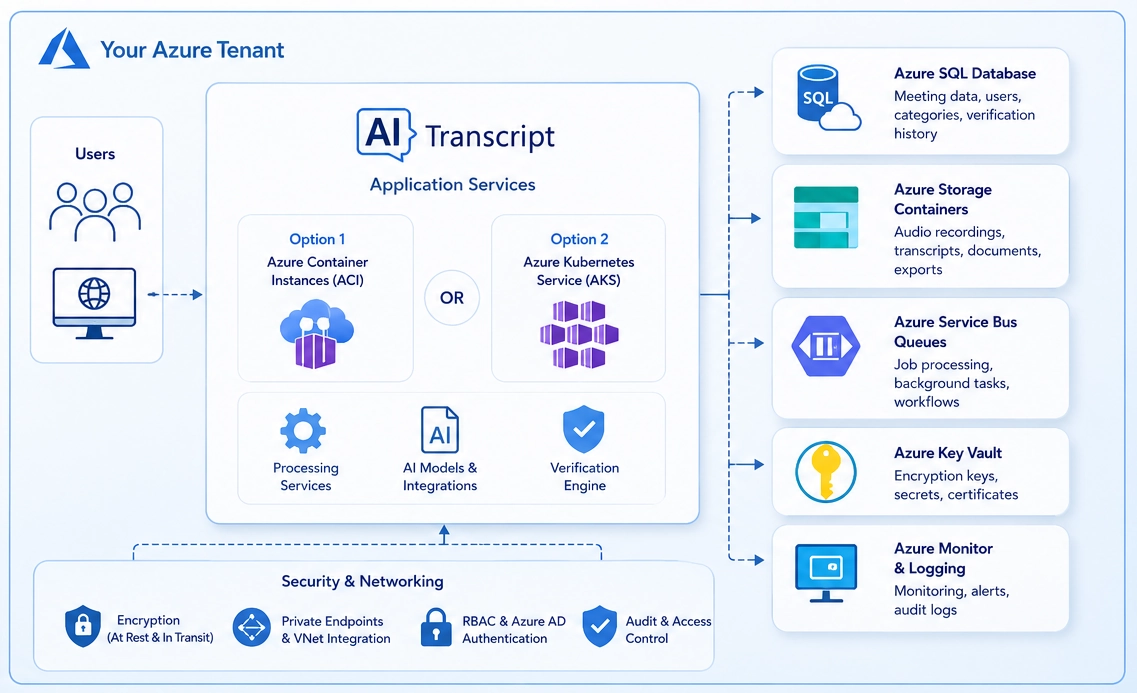
Three Core Components of AI-Transcript System
The system is built around three primary components, each designed to operate independently while working as a unified platform.
1. Desktop Application
A lightweight desktop application is distributed internally across the organization.
- Installed via corporate software distribution tools
- Connects securely using Microsoft authentication
- Allows users to upload and manage meeting recordings
- Interfaces directly with internal Azure services
This ensures ease of adoption without introducing external dependencies.
2. FastAPI Management Layer
A FastAPI-based service acts as the control layer of the system.
- Manages communication between components
- Connects to the corporate SQL database
- Handles requests, processing states, and orchestration logic
- Enables secure, remote interaction across services
This layer ensures the system remains structured, traceable, and manageable at scale.
3. Queue-Based Processing (Dockerised)
All transcription and processing workloads are handled through:
- Queue-driven architecture
- Asynchronous processing pipelines
- Docker-based deployment
This allows tasks such as transcription, keyword processing, and HITL preparation to run independently, in parallel, and efficiently.
Designed to Scale with Enterprise Demand
Processing requirements vary significantly across organizations.
AI-Transcript is built to scale dynamically using Azure-native services.
Azure Container Instances (ACI)
ACI enables rapid, on-demand scaling for processing workloads.
- Spin up containers only when needed
- No infrastructure management overhead
- Ideal for variable or burst workloads
- Cost-efficient for intermittent usage
This allows transcription jobs to be processed quickly without maintaining constant compute capacity.
Azure Kubernetes Service (AKS)
For larger or continuous workloads, AKS provides full orchestration capability.
- Manage large volumes of concurrent processing
- Ensure high availability and resilience
- Enable automated scaling and load balancing
- Maintain consistent performance across regions
AKS is suited for organizations where transcription becomes a core operational function.
Docker as the Foundation
All processing components are delivered as Docker images.
- Consistent deployment across environments
- Easy version control and updates
- Simplified scaling across ACI or AKS
- Alignment with modern DevOps practices
This ensures the system can evolve without disrupting operations.