Creating Trusted Meeting Records Through Transcript Verification
Version 1.0
Executive Summary
Creating Trusted Meeting Records Through Transcript Verification
Microsoft Teams has transformed the way organisations conduct meetings. It records conversations, generates transcripts, and, with the assistance of Artificial Intelligence, can produce meeting summaries and Minutes of Meeting within seconds.
These capabilities have significantly reduced the effort required to document meetings. However, they have also introduced a new challenge.
AI-generated meeting records are only as reliable as the transcript from which they are created.
Speech recognition may misidentify speakers, misunderstand technical terminology, or incorrectly interpret overlapping conversations. More importantly, AI cannot determine organisational intent, confirm commitments, or distinguish between ideas that were discussed and decisions that were actually made. When these inaccuracies remain unverified, they become part of the official meeting record and may influence future business decisions.
AI-Transcript addresses this challenge by introducing Transcript Verification—a structured methodology that combines Artificial Intelligence with human expertise to transform automatically generated transcripts into trusted organisational records.
Rather than generating Minutes of Meeting immediately after transcription, AI-Transcript first verifies the transcript itself. Artificial Intelligence performs an initial quality analysis, identifying ambiguities, inconsistencies, transcription errors, missing actions, and potential decisions. Meeting participants contribute their knowledge through a collaborative review process, while a designated Moderator evaluates all available evidence—including the original meeting recording—before approving the final transcript.
Only after this verification process is complete does AI-Transcript generate business documents such as Verified Minutes of Meeting, Executive Summaries, Action Registers, Decision Logs, and Risk Registers. Because these documents are derived from a verified transcript rather than an unverified transcription, they provide a more reliable representation of what actually occurred during the meeting.
The benefits extend beyond individual meetings.
Each verified transcript becomes part of a growing organisational knowledge base. Related meetings can be grouped into Meeting Categories, enabling organisations to search historical decisions, track commitments across projects, preserve corporate knowledge, and improve the consistency of future AI analysis. Every verified meeting contributes to a more accurate and valuable organisational memory.
This guide describes the AI-Transcript methodology, from acquiring meeting evidence through transcript analysis, participant collaboration, moderator verification, transcript approval, and the generation of trusted business documents. It also presents practical guidance for implementing transcript verification as part of an organisation's governance framework.
AI-Transcript does not replace Microsoft Teams or other AI meeting technologies. Instead, it complements them by adding the governance, verification, and accountability required when meeting records support operational, contractual, regulatory, or strategic business decisions.
As Artificial Intelligence continues to automate meeting documentation, the ability to verify that documentation becomes increasingly important. AI-Transcript introduces Transcript Verification as an essential business process, ensuring that organisations can move beyond simply generating meeting records to creating meeting records they can trust.
Foreword
Every day, millions of meetings take place using Microsoft Teams. These meetings shape projects, influence strategic decisions, allocate budgets, assign responsibilities, and establish commitments that affect the future of organisations.
Microsoft Teams records these meetings exceptionally well. It generates transcripts automatically, identifies speakers, and, with Microsoft 365 Copilot, can even produce meeting summaries within seconds.
Yet despite these remarkable advances in Artificial Intelligence, organisations continue to ask the same questions after important meetings:
"Who agreed to that?"
"I don't remember saying that."
"That isn't what I meant."
"Who owns this action?"
"Where was that decision made?"
These questions rarely arise because the meeting was poorly conducted. More often, they arise because the official record of the meeting cannot be trusted with complete confidence.
Artificial Intelligence is remarkably effective at converting speech into text. However, producing an accurate transcript is only the beginning. Creating reliable Minutes of Meeting requires understanding context, distinguishing overlapping conversations, recognising technical terminology, identifying the correct speakers, and capturing decisions, actions, owners, and deadlines precisely as they were intended.
A transcript that is 98 percent accurate can still produce incorrect meeting minutes if a single decision is misunderstood or an action is assigned to the wrong participant.
For organisations operating in project management, engineering, government, healthcare, legal services, finance, or any environment where meeting outcomes influence business decisions, "almost correct" is often insufficient.
AI-Transcript was developed to address this challenge.
Rather than replacing existing transcription technologies, AI-Transcript complements Microsoft Teams by introducing a structured verification process that transforms an automatically generated transcript into a trusted organisational record.
The philosophy behind AI-Transcript is straightforward:
Reliable Minutes of Meeting begin with a verified transcript.
Instead of asking Artificial Intelligence to produce better meeting minutes from imperfect information, AI-Transcript first improves the quality of the source material through a collaborative verification process involving Artificial Intelligence, meeting participants, and a designated moderator.
Every correction is traceable.
Every clarification is documented.
Every decision remains supported by the original meeting recording.
This process creates what AI-Transcript refers to as Dual Evidence Verification™—the ability to validate meeting content by both reading the transcript and listening to the corresponding audio. This approach significantly increases confidence in the final meeting record while preserving the historical integrity of the original discussion.
The result is not simply a better transcript.
It is a verified meeting record from which reliable Minutes of Meeting, action registers, decision logs, and organisational knowledge can be generated with confidence.
This document explains the methodology behind AI-Transcript. It describes not only how the system operates, but why each verification stage exists and how every participant contributes to producing an accurate, auditable, and trustworthy record of every Microsoft Teams meeting.
Chapter 1 - Why AI-Generated Meeting Minutes Are Not Enough
The Evolution of Meeting Documentation
The way organisations document meetings has changed dramatically over the past decade.
Not long ago, a meeting secretary manually recorded notes during discussions and later prepared the Minutes of Meeting. The quality of the final document depended largely on the note-taker's attention, interpretation, and ability to capture important decisions while simultaneously participating in the meeting.
Microsoft Teams transformed this process by introducing automatic meeting recording and speech-to-text transcription. Organisations could now preserve entire conversations instead of relying solely on handwritten notes or memory.
More recently, Large Language Models such as Microsoft 365 Copilot have taken another significant step forward by generating meeting summaries, identifying action items, and producing draft Minutes of Meeting automatically.
These technologies save considerable time and have become valuable productivity tools.
However, they also introduce a new assumption:
that the transcript itself is sufficiently accurate to be trusted without verification.
For many meetings this assumption is acceptable.
For important organisational decisions, it is not.
A Transcript Is Not the Meeting
A transcript represents an interpretation of spoken language.
It is not the meeting itself.
During every meeting people:
-
interrupt one another
-
finish each other's sentences
-
speak simultaneously
-
refer to earlier discussions
-
use abbreviations
-
mention internal project names
-
discuss technical terminology
-
change decisions during the conversation
-
correct themselves while speaking
Although humans naturally understand these situations, they present significant challenges for automated transcription systems.
A speech recognition engine cannot always determine whether a participant was asking a question, making a decision, expressing uncertainty, or simply thinking aloud.
Similarly, Artificial Intelligence cannot always distinguish between:
"Let's investigate this."
and
"We've decided to implement this."
To a human listener, the difference is obvious.
To an AI model reading text alone, both statements may appear similar.
The consequences, however, are very different.
Accuracy Is More Than Correct Words
Many organisations evaluate transcription quality by asking:
"How accurate is the transcript?"
This is an important question, but it is not the most important one.
A transcript may correctly recognise 98% of spoken words while still failing to produce reliable Minutes of Meeting.
Consider the following examples:
-
A speaker is incorrectly identified, causing an action item to be assigned to the wrong person.
-
A deadline of 15 June is transcribed as 50 June.
-
A technical product name is replaced with a similar-sounding common word.
-
Two people speak simultaneously, and one participant's agreement is omitted.
-
The AI identifies a suggestion as a formal decision.
Each individual error may appear minor.
Collectively, they can alter the meaning of the meeting.
For organisations that rely on meeting records for governance, compliance, project delivery, contractual obligations, or regulatory reporting, these inaccuracies introduce unnecessary risk.
The Missing Step
Most AI meeting solutions follow a simple workflow:
Meeting Recording → Transcript → AI Summary → Minutes of Meeting
AI-Transcript introduces an additional stage that fundamentally changes the reliability of the outcome:
Meeting Recording → Transcript → Verification → Verified Transcript → Minutes of Meeting
This verification stage combines artificial intelligence with human expertise.
Rather than replacing people, AI identifies areas that require attention, while participants and moderators contribute the contextual understanding that only humans possess.
The result is not simply a transcript with fewer spelling mistakes.
It is a meeting record that can be trusted as an accurate representation of what was discussed, agreed, and assigned.
Chapter 2 -Why Transcript Verification Matters
Information Becomes Valuable Only When It Can Be Trusted
Every meeting creates information.
Ideas are discussed.
Problems are identified.
Decisions are made.
Responsibilities are assigned.
Deadlines are agreed.
Risks are raised.
Questions are answered.
For many organisations, these discussions become official business records that influence projects, budgets, contractual obligations, regulatory compliance, and strategic direction.
Yet the value of these records depends on one fundamental characteristic:
Can they be trusted?
If participants question the accuracy of the meeting record, its value rapidly diminishes. Time is wasted debating what was said instead of progressing the work. Decisions are revisited, responsibilities become unclear, and confidence in the documentation is lost.
Trust, therefore, is not a desirable feature of meeting minutes—it is their primary purpose.
AI-Transcript was developed around this principle. The objective is not simply to produce meeting minutes faster, but to produce meeting records that participants and organisations can rely upon with confidence.
Accuracy Does Not Always Mean Understanding
Modern speech recognition systems have achieved remarkable levels of accuracy. Under favourable conditions they can recognise spoken words with impressive precision.
However, recognising words is fundamentally different from understanding meaning.
Consider the following statement:
"We'll leave that with Sarah."
Without additional context, this sentence could mean:
-
Sarah owns the action.
-
Sarah will investigate the issue.
-
Sarah is temporarily responsible.
-
Sarah will prepare a proposal.
-
Sarah simply agreed to follow up.
A human participant understands the intended meaning because they were present during the discussion.
An AI model reading only the transcript must infer the intent.
Sometimes that inference is correct.
Sometimes it is not.
Minutes of Meeting require interpretation as well as transcription.
This distinction lies at the heart of transcript verification.
The Cost of Small Errors
Most transcription errors appear insignificant when viewed individually.
A missing word.
A misheard name.
An incorrect number.
A missing speaker label.
A sentence split in the wrong location.
Yet business meetings rarely fail because of major errors.
Instead, they fail because numerous small inaccuracies accumulate until the overall understanding changes.
Consider the following examples.
Example 1 — Incorrect Speaker
A transcript incorrectly attributes a statement to David instead of Michael.
The resulting Minutes of Meeting assign responsibility to the wrong project manager.
No transcription engine considers this a major error.
The organisation certainly does.
Example 2 — Technical Terminology
A participant refers to the internal project "Phoenix."
The transcript records the word as "fee next."
The meeting summary no longer refers to the correct project.
Later searches fail to locate the discussion.
Knowledge has effectively been lost.
Example 3 — Missing Context
A participant says:
"Yes, let's proceed."
Without surrounding conversation this statement is meaningless.
Proceed with what?
Who agreed?
What assumptions were made?
What risks were discussed?
Only the meeting context provides the answer.
Example 4 — Missing Deadline
The transcript captures:
"John will prepare the report."
The original discussion was:
"John will prepare the report before next Thursday."
One missing phrase changes the action from a scheduled commitment into an undefined task.
None of these errors appears catastrophic.
Collectively they undermine confidence in the meeting record.
AI Cannot Verify What It Does Not Know
Large Language Models are extraordinarily capable at analysing language.
However, they share one important limitation.
They can only analyse the information available to them.
If the transcript contains:
-
incorrect speaker names,
-
missing words,
-
overlapping conversations,
-
inconsistent terminology,
-
fragmented sentences,
then every downstream AI process is affected.
This is often described as:
Garbage In → Garbage Out
AI-Transcript approaches the problem differently.
Instead of attempting to compensate for poor source information, it first improves the quality of the transcript itself.
Once the transcript has been verified, AI can generate significantly more reliable:
-
Minutes of Meeting
-
Decisions
-
Action Items
-
Risk Registers
-
Executive Summaries
-
Knowledge Base Entries
Verification therefore improves every subsequent AI process.
Verification Is a Collaborative Process
One of the misconceptions surrounding Artificial Intelligence is that it should replace human judgement.
In reality, successful enterprise AI systems combine the strengths of both.
Artificial Intelligence excels at:
-
analysing large volumes of information,
-
recognising patterns,
-
identifying inconsistencies,
-
detecting possible issues,
-
summarising discussions,
-
maintaining consistency.
Humans excel at:
-
understanding intent,
-
recognising organisational context,
-
interpreting technical terminology,
-
resolving ambiguity,
-
judging business significance,
-
making final decisions.
AI-Transcript deliberately combines these complementary strengths.
Artificial Intelligence performs the initial analysis.
Meeting participants contribute clarification where required.
The moderator evaluates all proposed changes before updating the official transcript.
This collaborative workflow ensures that technology accelerates the verification process without replacing human accountability.
From Transcription to Verification
Traditional meeting solutions focus on creating transcripts.
AI-Transcript focuses on creating verified evidence.
This distinction is fundamental.
A transcript answers the question:
"What words were recognised?"
A verified transcript answers a much more valuable question:
"What did the participants actually agree?"
The difference may appear subtle, yet it determines whether the resulting Minutes of Meeting can be trusted as an official organisational record.
Verification transforms a transcript from a convenient reference into reliable business evidence.
Dual Evidence Verification™
One of the defining principles of AI-Transcript is Dual Evidence Verification™.
Rather than relying solely on written text, AI-Transcript enables moderators and participants to validate transcript segments using two independent sources of evidence:
The transcript — what the speech recognition engine interpreted.
The original meeting audio — what participants actually said.
This combination significantly reduces uncertainty.
Reading alone may overlook transcription mistakes.
Listening alone may make it difficult to locate specific discussions.
Together, they provide a practical and efficient verification process.
Whenever uncertainty exists, the transcript can be compared directly with the original recording, allowing decisions to be based on evidence rather than assumptions.
This capability is particularly valuable when reviewing important decisions, disputed statements, technical terminology, or overlapping conversations where transcription confidence may be reduced.
Building Confidence Before Building Minutes
Many AI meeting solutions immediately generate meeting summaries after transcription.
AI-Transcript deliberately introduces a verification stage before creating Minutes of Meeting.
This additional step serves a simple purpose:
Confidence first. Automation second.
By resolving transcription issues, confirming speakers, validating terminology, and incorporating participant knowledge before generating meeting minutes, AI-Transcript produces records that more accurately reflect the discussions that actually took place.
The result is not merely a better transcript.
It is a stronger foundation upon which reliable Minutes of Meeting, action registers, decision logs, and organisational knowledge can be built.
Verification Creates Trust
Ultimately, transcript verification is not about correcting spelling mistakes or improving punctuation.
It is about creating confidence.
Confidence that decisions have been captured correctly.
Confidence that responsibilities have been assigned to the right people.
Confidence that important context has not been lost.
Confidence that meeting minutes accurately represent what participants intended.
When organisations trust their meeting records, they spend less time resolving disputes, repeating discussions, or searching for forgotten decisions. Instead, meetings become a dependable source of organisational knowledge.
This is the purpose of AI-Transcript.
Not simply to transcribe conversations.
But to transform conversations into trusted business records.
**
Chapter 3 - The AI-Transcript Methodology
From Automatic Transcription to Trusted Meeting Records
Every Microsoft Teams meeting generates valuable information.
Unfortunately, valuable information does not automatically become reliable information.
While modern Artificial Intelligence can convert speech into text with remarkable accuracy, producing trustworthy Minutes of Meeting requires considerably more than speech recognition. It requires understanding context, resolving ambiguity, confirming technical terminology, identifying the correct speakers, and ensuring that important decisions are represented exactly as participants intended.
For this reason, AI-Transcript does not treat transcript generation as the end of the process.
It treats it as the beginning.
The AI-Transcript Methodology is a structured verification process that combines Artificial Intelligence with human expertise to progressively improve the quality of meeting information before Minutes of Meeting are generated.
Each phase builds upon the previous one, increasing confidence in the transcript while preserving complete traceability back to the original meeting recording.
Rather than asking AI to "guess better," AI-Transcript systematically improves the quality of the evidence available to AI.
The result is a verified transcript from which reliable meeting minutes can be produced.
The Verification Philosophy
Traditional AI meeting applications typically follow a straightforward workflow.
Meeting Recording
↓
Speech Recognition
↓
Transcript
↓
AI Summary
↓
Minutes of Meeting
This approach is efficient but assumes that the transcript is already sufficiently accurate.
AI-Transcript introduces a fundamentally different philosophy.
Meeting Recording
↓
Speech Recognition
↓
AI Analysis
↓
Human Verification
↓
Moderator Approval
↓
Verified Transcript
↓
AI Minutes of Meeting
↓
Trusted Organisational Record
Instead of generating meeting minutes immediately, AI-Transcript first validates the information upon which those minutes will be based.
The quality of the final Minutes of Meeting therefore depends not only on Artificial Intelligence but also on structured human verification supported by the original meeting recording.
The Eight Verification Phases
The AI-Transcript methodology consists of eight connected phases.
Each phase contributes to improving the accuracy, completeness, and reliability of the final meeting record.
These phases are not independent tasks. Together they form a continuous verification workflow that transforms an automatically generated transcript into a trusted organisational document.
Phase 1 — Acquire
Collecting the Meeting Evidence
The verification process begins by gathering all available information relating to the meeting.
Typically this includes:
-
Microsoft Teams transcript (.VTT)
-
Meeting recording (.MP4)
-
Attendance report
-
Meeting agenda
-
Supporting documents such as Word, PDF, HTML or text files
Each item contributes additional context.
The transcript provides the spoken content.
The meeting recording provides the original evidence.
The attendance report assists with speaker identification.
The agenda introduces expected topics, technical terminology, project names, and discussion objectives.
Rather than analysing isolated text, AI-Transcript begins with the richest possible understanding of the meeting.
Phase 2 — Analyse
Artificial Intelligence Performs the First Review
Once meeting data has been imported, AI performs a detailed examination of the transcript.
Unlike traditional summarisation tools, AI-Transcript does not immediately attempt to write Minutes of Meeting.
Instead, it searches for issues that may reduce the reliability of the final meeting record.
Examples include:
-
unidentified speakers
-
inconsistent terminology
-
incomplete statements
-
conflicting information
-
unclear decisions
-
missing owners
-
missing deadlines
-
ambiguous wording
-
possible transcription errors
Artificial Intelligence effectively performs the first quality assurance review, allowing moderators and participants to focus only on areas that genuinely require attention.
Phase 3 — Verify
Confirming Speakers and Organisational Terminology
Before reviewing meeting content, the transcript itself must accurately represent who participated in the discussion.
AI-Transcript therefore verifies:
-
speaker identities
-
technical terminology
-
company jargon
-
product names
-
customer names
-
acronyms
-
project names
Moderators can listen to short audio samples to confirm speaker identities.
Similarly, AI identifies specialised terminology throughout the transcript for review.
A single correction automatically updates every occurrence throughout the transcript, creating consistency before deeper analysis begins.
Phase 4 — Collaborate
Participants Contribute Their Knowledge
No Artificial Intelligence possesses the same understanding of a meeting as the people who actually attended it.
Participants therefore play an important role in transcript verification.
Rather than editing the transcript directly, participants review transcript segments and submit structured comments.
They may:
-
report transcription errors
-
clarify ambiguous discussions
-
explain missing context
-
identify incorrect terminology
-
highlight overlooked decisions
-
identify missing actions
-
suggest improvements
Every comment is recorded together with the identity of the contributor, providing accountability while preserving the integrity of the original transcript.
Collaboration enriches the transcript without compromising its historical accuracy.
Phase 5 — Moderate
Establishing the Official Meeting Record
The moderator serves as the final authority responsible for producing the verified transcript.
Unlike participants, moderators can evaluate every submitted issue and determine how it should affect the official meeting record.
Each proposed change is considered alongside:
-
participant comments
-
AI observations
-
neighbouring transcript segments
-
original meeting audio
This evidence-based review ensures that every modification is supported by objective information rather than personal interpretation.
The moderator therefore transforms collaborative feedback into a consistent and authoritative transcript.
Phase 6 — Approve
Verifying the Transcript
Once all significant issues have been resolved, the transcript is ready for formal approval.
Signing off the transcript confirms that:
-
speaker identities have been verified
-
important terminology is correct
-
identified issues have been reviewed
-
participant feedback has been considered
-
transcript corrections have been applied where appropriate
-
annotations accurately capture additional context
Approval represents much more than pressing a button.
It signifies that the transcript has become the organisation's trusted representation of the meeting.
Phase 7 — Generate
Creating Reliable Minutes of Meeting
Only after verification is complete does AI generate the Minutes of Meeting.
At this stage, Artificial Intelligence works from significantly higher-quality information than would normally be available.
Consequently, AI can produce more reliable:
-
executive summaries
-
action registers
-
decision logs
-
key discussion points
-
follow-up activities
-
meeting outcomes
Rather than attempting to compensate for transcription problems, AI now operates upon information that has already been validated by both people and technology.
Phase 8 — Learn
Building Organisational Intelligence
Every verified meeting contributes to the organisation's growing knowledge base.
Verified transcripts become significantly more valuable than isolated meeting records.
Over time they enable organisations to:
-
search historical decisions
-
trace actions across multiple meetings
-
monitor recurring issues
-
maintain consistent terminology
-
preserve organisational knowledge
-
improve future AI analysis
Each verified meeting therefore strengthens every future meeting.
The organisation gradually develops a reliable repository of trusted business knowledge rather than simply accumulating thousands of disconnected transcripts.
Artificial Intelligence and Human Intelligence Working Together
The AI-Transcript methodology deliberately combines the strengths of Artificial Intelligence with the experience of meeting participants.
Artificial Intelligence excels at analysing information quickly and consistently.
Humans excel at understanding meaning, context, organisational knowledge, and business intent.
Neither performs optimally in isolation.
Together they create a verification process that is both efficient and dependable.
AI identifies where attention is required.
Participants contribute their knowledge.
Moderators exercise judgement.
The result is a verified transcript supported by both computational analysis and human expertise.
Trust Is Built Incrementally
Verification is not a single event.
It is a sequence of improvements.
Each phase removes uncertainty from the meeting record.
Speaker identities become more reliable.
Technical terminology becomes more accurate.
Context becomes clearer.
Decisions become better defined.
Actions become more complete.
Responsibilities become more certain.
By the time Minutes of Meeting are generated, the underlying transcript has undergone multiple independent levels of review.
This layered approach significantly increases confidence in the final meeting record while maintaining complete traceability back to the original Microsoft Teams recording.
Beyond Meeting Minutes
Although AI-Transcript ultimately generates Minutes of Meeting, its methodology serves a much broader purpose.
It creates an auditable process for transforming conversations into trusted organisational knowledge.
Verified transcripts can support:
-
project governance
-
quality management
-
compliance and audit
-
contractual evidence
-
decision tracking
-
organisational learning
-
knowledge retention
Meeting minutes are therefore not the final product.
They are one valuable outcome of a much richer verification process.
Conclusion
The AI-Transcript Methodology recognises a simple but important truth:
Reliable Minutes of Meeting cannot be created from uncertain information.
Before AI can produce trustworthy outcomes, the transcript itself must earn that trust.
By combining Artificial Intelligence, collaborative review, moderator oversight, and direct access to the original meeting recording, AI-Transcript transforms automatic transcription into a structured process of evidence-based verification.
The result is more than a transcript.
It is a trusted organisational record upon which decisions, actions, compliance, and future organisational knowledge can confidently be built.
**
Chapter 4 - Understanding Microsoft Teams Transcripts
Why Transcript Quality Determines the Quality of Meeting Minutes
The quality of every set of Minutes of Meeting begins with the quality of the transcript from which those minutes are created.
This principle may appear obvious, yet it is frequently overlooked.
Modern Artificial Intelligence can analyse text with remarkable sophistication. It can identify decisions, extract action items, summarise discussions, detect risks, and generate executive reports. However, every one of these capabilities depends upon a single assumption:
The transcript accurately represents what was said during the meeting.
If that assumption is incorrect, every subsequent AI-generated output becomes progressively less reliable.
AI-Transcript was developed with this understanding. Rather than accepting the Microsoft Teams transcript as a finished product, it treats the transcript as the starting point of a structured verification process.
To appreciate why this additional verification is necessary, it is useful to understand how Microsoft Teams transcripts are produced and where their limitations originate.
How Microsoft Teams Creates a Transcript
During a meeting, Microsoft Teams continuously converts spoken audio into text using automatic speech recognition (ASR).
The transcript is generated in real time and records:
-
when speech begins
-
when speech ends
-
the recognised speaker (where available)
-
the recognised text
The resulting transcript is typically exported as a .VTT (Web Video Text Tracks) file.
A VTT transcript is designed primarily to display subtitles while a recording is playing. It was never intended to become an official business document or the foundation for legally significant Minutes of Meeting.
Consequently, although VTT files contain valuable information, they also contain characteristics that make them difficult to read and even more difficult for Artificial Intelligence to interpret accurately.
A Transcript Is Optimised for Playback, Not Reading
The purpose of subtitles is very different from the purpose of meeting minutes.
Subtitles aim to display small portions of text synchronised with video playback.
Meeting minutes aim to capture meaning, decisions, actions, and responsibilities.
To satisfy subtitle requirements, speech is frequently divided into short fragments.
For example, the spoken sentence:
"I think we should complete the migration before the end of August because the customer expects the new system to be operational in September."
may appear in a transcript as:
I think we should
complete the migration
before the end
of August
because the customer
expects the new system
to be operational
in September.
Although perfectly suitable for subtitle display, this fragmented structure makes continuous reading difficult.
It also reduces the ability of AI models to understand the complete context of the discussion.
Oversplit Utterances
One of the most common characteristics of Microsoft Teams transcripts is the splitting of a single spoken thought into multiple independent transcript segments.
This occurs because speech recognition engines continuously divide speech according to timing constraints rather than grammatical structure.
The result is known as oversplit utterances.
Instead of one coherent statement, readers encounter multiple disconnected fragments.
For people reading the transcript, this interrupts the natural flow of conversation.
For Artificial Intelligence, excessive fragmentation reduces contextual understanding.
AI-Transcript addresses this by intelligently merging consecutive transcript segments belonging to the same speaker whenever they represent a continuous thought.
This process significantly improves readability without altering the original meaning of the discussion.
Cross-Talk and Overlapping Conversations
Meetings are rarely conducted as orderly sequences in which each participant waits patiently for another to finish.
People interrupt.
Participants agree while someone else is still speaking.
Questions overlap with answers.
Several people may respond simultaneously.
Humans handle these situations naturally.
Automatic transcription systems face a much greater challenge.
Consider the following example.
At 10:04:15, one participant begins speaking.
Two seconds later another participant interrupts.
Both continue speaking for several seconds.
The meeting recording therefore contains two voices occupying the same period of time.
A transcript may correctly recognise both conversations, but when displayed chronologically the resulting text becomes difficult to follow.
This is one of the principal reasons why reading a raw transcript often feels confusing despite accurate speech recognition.
Time and Human Perception
Imagine three participants speaking almost simultaneously.
Although all three conversations occur during approximately five seconds of real time, a person reading the transcript expects to process them sequentially.
Reading is inherently linear.
Conversation is not.
This difference creates an important challenge.
Simply replaying the original recording does not always help because multiple speakers are talking at the same time.
Consequently, users need a practical way of navigating these overlapping discussions while still preserving the integrity of the original recording.
AI-Transcript's Reconstruction Process
Rather than accepting the raw transcript exactly as produced by Microsoft Teams, AI-Transcript performs several reconstruction steps before verification begins.
These processes do not alter the original evidence.
Instead, they reorganise transcript presentation to improve readability and verification.
The reconstruction process includes:
Chronological Realignment
Transcript segments are reorganised to create a clearer chronological reading order while preserving their relationship to the original recording.
This enables users to follow conversations more naturally.
Smart Speaker Merging
Consecutive transcript segments belonging to the same speaker are intelligently merged into complete conversational statements.
Instead of reading multiple disconnected fragments, moderators see coherent thoughts that are easier to understand and verify.
This dramatically improves both human readability and AI comprehension.
Transcript Normalisation
Minor formatting inconsistencies are standardised.
These include:
-
unnecessary line breaks
-
duplicated spacing
-
inconsistent punctuation
-
fragmented sentence boundaries
Normalisation improves readability while leaving the spoken content unchanged.
Sequential Playback Windows
One of the most distinctive innovations within AI-Transcript is its playback methodology.
Traditional transcript viewers simply jump to the corresponding timestamp within the meeting recording.
This works well when only one participant is speaking.
It becomes considerably less effective during overlapping conversations.
AI-Transcript introduces what it refers to as Sequential Playback Windows.
Rather than replaying the recording exactly as a media player would, AI-Transcript constructs a virtual playback sequence that follows the reconstructed transcript presented to the moderator.
The original recording remains unchanged.
Only the playback navigation changes.
As moderators review transcript excerpts, AI-Transcript automatically calculates the relevant portions of the meeting recording required for that specific discussion.
The result is a listening experience that closely follows the reconstructed transcript while still preserving the original meeting evidence.
This significantly improves transcript verification during complex conversations involving interruptions or overlapping speech.
Reading and Listening Together
Traditional transcript review relies almost entirely upon reading.
AI-Transcript introduces a second verification channel.
Every important transcript segment can be examined in two ways:
Read the transcript.
Listen to the original recording.
If uncertainty exists, moderators no longer need to search manually through a lengthy meeting recording.
The corresponding audio is immediately available.
This combination dramatically improves verification efficiency while reducing the likelihood of transcription errors remaining undetected.
Throughout this document, this methodology is referred to as Dual Evidence Verification™.
Why Verification Is Still Necessary
It is important to recognise that Microsoft Teams is not performing incorrectly.
Its transcription engine performs exceptionally well considering the complexity of natural human conversation.
The limitations arise because speech recognition and meeting governance serve different purposes.
Microsoft Teams aims to capture spoken words.
AI-Transcript aims to establish trusted organisational records.
These objectives are related but fundamentally different.
For this reason, transcript verification should not be viewed as correcting Microsoft Teams.
It should be viewed as preparing valuable business information for reliable decision-making.
From Raw Transcript to Trusted Evidence
The transformation performed by AI-Transcript can be summarised simply.
A Microsoft Teams transcript is an excellent starting point.
It captures the conversation.
AI-Transcript then enhances that conversation through structured verification.
Speaker identities are confirmed.
Terminology is corrected.
Context is clarified.
Ambiguities are resolved.
Participant knowledge is incorporated.
Moderator judgement is applied.
The resulting transcript becomes substantially more valuable than the original because it is no longer simply a record of recognised speech.
It becomes verified evidence.
Only at this stage does AI generate Minutes of Meeting.
This distinction is central to the AI-Transcript methodology.
The objective is not merely to transcribe meetings.
The objective is to create trusted organisational knowledge.
Conclusion
Every Microsoft Teams transcript contains valuable information.
However, value alone is insufficient.
Before meeting transcripts can support governance, compliance, project delivery, or organisational learning, they must first become trustworthy.
AI-Transcript achieves this transformation by reconstructing, analysing, and verifying transcript content before any meeting minutes are generated.
The next chapter introduces the first operational stage of this methodology: importing meeting information and preparing the evidence that forms the foundation of the entire verification process.
Chapter 5 - Phase 1 Acquiring the Meeting Evidence
Building a Reliable Foundation
Every successful verification process begins with one principle:
The quality of the final Minutes of Meeting can never exceed the quality of the information used to create them.
Artificial Intelligence is exceptionally capable at analysing information. However, regardless of the sophistication of the AI model, it cannot infer information that was never provided or reconstruct details that were lost before analysis began.
For this reason, the first phase of the AI-Transcript methodology is not AI analysis.
It is evidence acquisition.
Before any transcript is examined, AI-Transcript gathers all available information relating to the meeting. Each additional source provides context that improves the understanding of what occurred and reduces the likelihood of incorrect assumptions later in the verification process.
This approach mirrors the practices used in professional investigations and quality management systems: conclusions should never be based on a single source of evidence when additional evidence is available.
Meeting Evidence
A Microsoft Teams meeting generates considerably more information than the transcript alone.
AI-Transcript combines multiple evidence sources into a single verification project.
Typical meeting evidence includes:
-
Microsoft Teams transcript (.VTT)
-
Microsoft Teams meeting recording (.MP4)
-
Attendance report
-
Meeting agenda
-
Supporting documents
-
Company terminology and project-specific vocabulary
Each contributes a different perspective to the meeting.
Together, they provide the context required for accurate transcript verification.
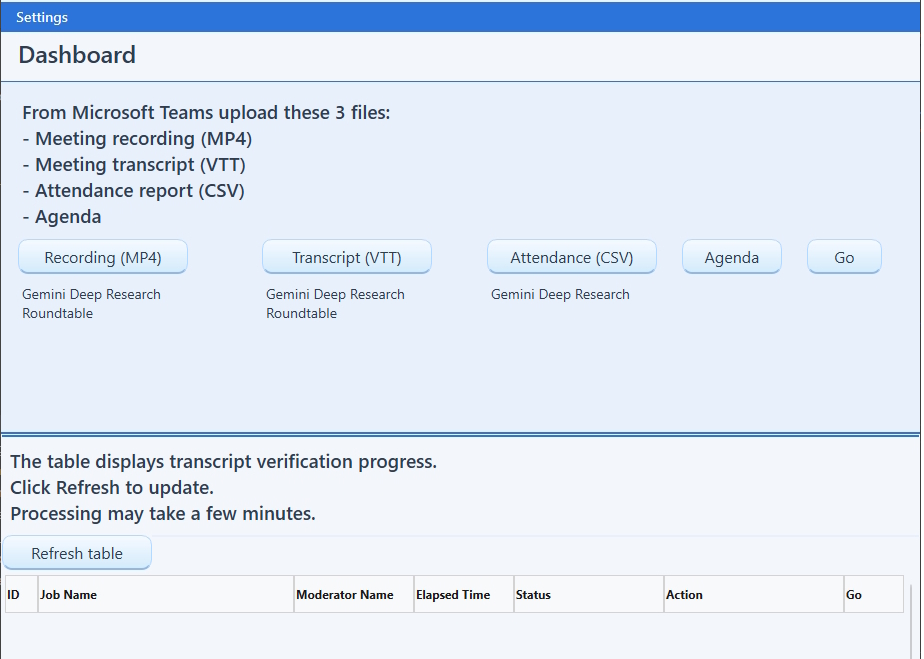
: Importing Microsoft Teams video vtt and csv and agenda files
The Microsoft Teams Transcript
The transcript is the primary working document throughout the verification process.
It contains:
-
recognised speech
-
speaker information (where available)
-
timestamps
-
chronological sequence of the discussion
The transcript becomes the foundation upon which AI analysis, participant review, moderator verification, and Minutes of Meeting generation are built.
Although the transcript forms the centre of the workflow, it should not be regarded as the sole source of truth.
Instead, it represents the first interpretation of the meeting, generated automatically by speech recognition technology.
The purpose of AI-Transcript is to progressively verify and improve that interpretation.
The Meeting Recording
While the transcript provides recognised text, the meeting recording preserves the original conversation exactly as it occurred.
It is the authoritative evidence against which transcript content can be verified.
Whenever uncertainty exists, moderators can return to the original recording to determine:
-
whether words were recognised correctly
-
whether speaker identification is accurate
-
whether the tone or intent has been misunderstood
-
whether overlapping speech affected transcription quality
-
whether important information has been omitted
Unlike traditional transcript review systems, AI-Transcript integrates audio playback directly into the verification process.
Moderators do not need to manually search through an hour-long recording to locate a specific discussion.
Relevant audio excerpts are immediately available alongside the transcript, significantly reducing the time required to verify complex conversations.
Attendance Report
Meetings frequently contain participants with similar voices or incomplete speaker identification.
The Microsoft Teams attendance report provides valuable supplementary information, including:
-
participant names
-
attendance duration
-
meeting join and leave times
This information assists the moderator when confirming speaker identities.
Correct speaker identification is particularly important because decisions and action items become associated with individual participants.
An incorrectly identified speaker may result in an action being assigned to the wrong person, potentially affecting project delivery and accountability.
The Meeting Agenda
The meeting agenda is one of the most valuable yet frequently overlooked sources of contextual information.
Many organisations already prepare agendas before important meetings.
Unfortunately, once the meeting concludes, these documents are often ignored during transcript analysis.
AI-Transcript treats the agenda as an important source of business context.
An agenda typically contains:
-
discussion topics
-
project names
-
customer names
-
technical terminology
-
expected decisions
-
planned objectives
By analysing the agenda before reviewing the transcript, AI develops a better understanding of the meeting's intended subject matter.
For example, if the agenda refers to Project Orion, AI is significantly less likely to misinterpret that name as similar-sounding everyday language.
Similarly, if the agenda contains specialised engineering terminology, product names, or organisational acronyms, AI gains valuable contextual information before transcript verification begins.
The agenda therefore improves understanding without altering the transcript itself.
Supporting Documents
Many meetings involve supporting material such as:
-
project proposals
-
technical specifications
-
policy documents
-
contracts
-
reports
-
presentations
-
design documents
AI-Transcript allows these documents to be imported alongside the transcript.
These documents provide additional business context that enables AI to recognise terminology, understand references made during discussion, and interpret statements more accurately.
For example, participants may repeatedly refer to:
"Option Three"
Without supporting documentation, AI cannot determine what "Option Three" represents.
When the relevant proposal or presentation is available, AI can understand the discussion with considerably greater accuracy.
Company Terminology
Every organisation develops its own language.
Internal project names.
Product codes.
Department abbreviations.
Customer identifiers.
Technical jargon.
Industry-specific terminology.
Although these terms are perfectly understandable to employees, they frequently challenge speech recognition systems.
Consequently, unusual terminology may be transcribed inconsistently throughout a meeting.
AI-Transcript identifies these terms early in the verification process and presents them for confirmation.
Once verified, consistent terminology is maintained throughout the transcript.
This improves readability while also increasing the accuracy of subsequent AI analysis.
Why More Context Produces Better AI
Artificial Intelligence does not think like a human.
Instead, it predicts meaning from available information.
The more contextual information AI receives, the better those predictions become.
Consider the sentence:
"We'll proceed with Phoenix."
Without context, Phoenix could refer to:
-
a software product
-
a customer
-
a project
-
a city
-
a company
-
a code name
If the meeting agenda clearly identifies Phoenix as the name of a migration project, AI immediately understands the intended meaning.
Providing additional context reduces ambiguity before it becomes a problem.
Creating a Verification Project
Once all available evidence has been imported, AI-Transcript creates a single verification project.
Rather than treating each file independently, the system links all evidence together into one coherent meeting record.
This project becomes the working environment for the remainder of the verification process.
Every participant reviews the same transcript.
Every comment relates to the same evidence.
Every moderator decision remains traceable to the original meeting recording.
This integrated approach ensures consistency throughout the entire verification lifecycle.
Preserving the Original Evidence
An important principle of the AI-Transcript methodology is that original evidence is never replaced.
The imported transcript remains preserved.
The original meeting recording remains unchanged.
Attendance reports remain intact.
Supporting documents remain available.
Verification does not overwrite evidence.
Instead, it builds upon it.
Corrections, annotations, participant comments, moderator decisions, and AI observations become additional layers of information associated with the original meeting.
This approach preserves complete traceability and supports future review or audit if required.
A Strong Foundation for Verification
The acquisition phase may appear straightforward, yet it is one of the most important stages of the entire methodology.
Every subsequent phase depends upon the quality and completeness of the evidence collected at the beginning of the process.
Missing recordings reduce verification capability.
Missing agendas reduce contextual understanding.
Missing attendance reports complicate speaker identification.
Conversely, comprehensive meeting evidence allows Artificial Intelligence and human reviewers to work from a common, well-informed understanding of the meeting.
Verification therefore begins long before anyone reviews the transcript.
It begins with collecting the right evidence.
Conclusion
The objective of the acquisition phase is not simply to upload files.
It is to establish a complete and trustworthy foundation for transcript verification.
By combining transcripts, recordings, attendance information, agendas, supporting documentation, and organisational terminology into a single verification project, AI-Transcript ensures that every later decision is based on the richest possible understanding of the meeting.
With the evidence now assembled, the methodology moves to its next stage: AI Transcript Analysis, where Artificial Intelligence performs the initial quality review and identifies issues that may affect the reliability of the final Minutes of Meeting.
Chapter 6 - Phase 2 AI Transcript Analysis
Artificial Intelligence as the First Reviewer
Once the meeting evidence has been collected, AI-Transcript begins the first stage of transcript verification.
This stage is intentionally different from most AI meeting applications.
Many meeting solutions immediately attempt to produce a meeting summary or draft Minutes of Meeting from the raw transcript. While this approach is fast, it assumes that the transcript is already complete, accurate, and ready for interpretation.
AI-Transcript takes a different approach.
Instead of immediately generating Minutes of Meeting, Artificial Intelligence first asks a more important question:
"Can this transcript be trusted?"
Only after that question has been answered does the system proceed towards creating the final meeting record.
This philosophy changes the role of Artificial Intelligence from a document generator into an intelligent quality assurance analyst.
Analysing Before Summarising
The objective of AI Transcript Analysis is not to rewrite the meeting.
Its purpose is to identify anything that may prevent the creation of accurate Minutes of Meeting.
Artificial Intelligence examines the transcript much like an experienced meeting facilitator would.
It looks for:
-
inconsistencies
-
ambiguity
-
missing information
-
possible transcription errors
-
incomplete decisions
-
missing responsibilities
-
unclear action items
-
technical terminology
-
contextual problems
Rather than making changes automatically, AI prepares a structured review for the moderator and meeting participants.
Human judgement always remains central to the verification process.
A Professional Transcript Quality Analyst
AI-Transcript instructs the Large Language Model to adopt the role of a professional transcript quality analyst rather than a meeting summariser.
Instead of asking:
"Please summarise this meeting."
the system asks questions such as:
-
Are any statements incomplete?
-
Is the speaker identification reliable?
-
Are decisions clearly expressed?
-
Are action owners identified?
-
Are deadlines specified?
-
Does any discussion require clarification?
-
Are technical terms used consistently?
-
Are there conflicting statements?
-
Is additional context required?
This subtle difference significantly improves the quality of later AI-generated Minutes of Meeting because problems are identified before summarisation begins.
Looking Beyond Grammar
Traditional grammar correction tools focus on spelling, punctuation, and sentence structure.
AI-Transcript goes considerably further.
It examines whether the transcript accurately represents the business discussion.
For example, the following sentence may be grammatically correct:
"We'll finish that next month."
However, from a governance perspective the statement raises several questions:
-
Who will finish it?
-
Which task?
-
Which month?
-
Was this a commitment or merely a suggestion?
Although grammatically correct, the statement lacks sufficient information to become an action item.
AI therefore identifies it as requiring clarification.
Categories of AI Findings
During analysis, AI organises potential issues into structured categories.
These categories later become the basis of participant collaboration and moderator review.
The principal categories include:
Transcript Blockers
Issues that prevent reliable Minutes of Meeting from being created.
Examples include:
-
missing decisions
-
missing owners
-
missing deadlines
-
conflicting statements
-
unknown speakers
-
significant transcription errors
These issues require attention before the transcript can be considered complete.
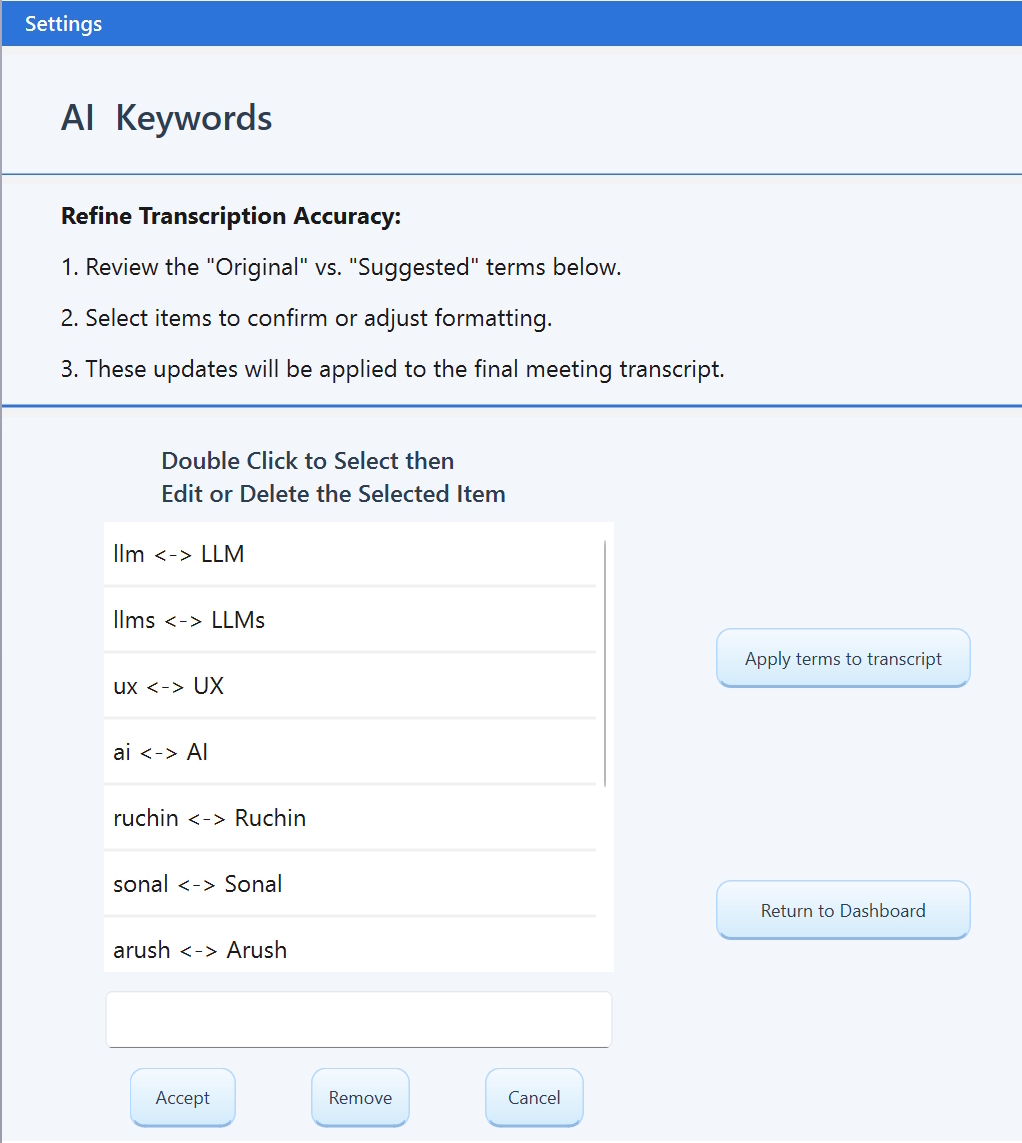
Figure 2: Keywords found by AI and suggested correct spelling
Corrections
Objective errors within the transcript.
These may include:
-
incorrect speaker names
-
misheard words
-
incorrect numbers
-
duplicated text
-
incorrect terminology
Corrections improve factual accuracy without changing the meaning of the meeting.
Clarifications
Statements that require additional explanation before they can be interpreted correctly.
Examples include:
-
ambiguous wording
-
missing context
-
undefined acronyms
-
incomplete statements
-
unclear references
Clarifications improve understanding rather than correcting mistakes.
Suggestions
Recommendations intended to improve the usefulness of the final Minutes of Meeting.
Examples include:
-
extracting action items
-
identifying decisions
-
highlighting risks
-
identifying key discussion points
-
recommending transcript restructuring
Suggestions enhance the value of the transcript without altering historical evidence.
AI Identifies — Humans Decide
An important principle of AI-Transcript is that Artificial Intelligence does not determine the official meeting record.
AI identifies observations.
Humans make decisions.
For example, AI may report:
"This statement appears to contain a decision."
The moderator determines whether that observation is correct.
Similarly, AI may identify:
"Action owner appears to be missing."
Meeting participants may later clarify who accepted responsibility.
The moderator then decides whether and how the transcript should be updated.
This approach prevents AI from introducing unsupported assumptions into official meeting records.
Confidence Rather Than Certainty
Artificial Intelligence rarely operates with absolute certainty.
Instead, it evaluates probabilities based upon available information.
AI-Transcript therefore treats AI findings as recommendations for review, not as unquestionable facts.
Some issues are immediately obvious.
Others require human interpretation.
For example:
An incorrectly recognised product name may be confidently identified as an error.
Whether a participant actually committed to performing a task may require discussion among those who attended the meeting.
Recognising this distinction helps maintain confidence in the verification process.
AI as an Intelligent Assistant
Throughout the analysis stage, Artificial Intelligence performs the repetitive work that would otherwise consume significant moderator time.
Instead of reading an entire transcript searching for possible issues, moderators receive a prioritised list of observations.
This dramatically improves efficiency.
Rather than reviewing every sentence equally, attention is focused where it is genuinely required.
Artificial Intelligence therefore becomes an assistant that enhances human productivity rather than replacing human judgement.
Preparing for Collaboration
Once analysis is complete, AI-Transcript creates a structured verification project.
Each identified issue becomes linked to its corresponding transcript segment.
Participants and moderators no longer need to search manually through hundreds or thousands of transcript entries.
Instead, every observation is presented together with:
-
the transcript excerpt
-
speaker information
-
surrounding context
-
playback controls
-
issue category
This organisation transforms transcript review from an unstructured reading exercise into a focused verification workflow.
Background Processing
The analysis performed by AI is computationally intensive and may require several minutes depending on:
-
meeting duration
-
transcript size
-
number of participants
-
supporting documents
-
complexity of discussion
For this reason, AI-Transcript performs transcript analysis as a background process.
Users are not required to remain connected while processing occurs.
Once analysis has completed, users receive notification that the verification project is ready for review.
This approach allows organisations to analyse lengthy meetings without interrupting normal work.
Why This Stage Matters
At first glance, AI Transcript Analysis may appear to be an optional convenience.
In reality, it is one of the most important stages of the methodology.
Without intelligent pre-analysis:
-
moderators would manually inspect every transcript line,
-
participants would spend time searching for issues,
-
important ambiguities could remain unnoticed,
-
significant decisions might be overlooked.
AI dramatically reduces this effort by directing human attention precisely where it is needed.
Instead of replacing people, AI helps people spend their time more effectively.
The Foundation for Human Verification
Artificial Intelligence is exceptionally effective at identifying where uncertainty may exist.
Humans are exceptionally effective at resolving that uncertainty.
The AI analysis stage bridges these complementary strengths.
It provides the roadmap for every subsequent phase of transcript verification.
Participants know which discussions require attention.
Moderators understand where evidence should be reviewed.
The verification process becomes organised, consistent, and repeatable.
Only after this preparation does the methodology move to the next stage:
Speaker Verification and Organisational Terminology, where the transcript begins its transformation from an automatically generated document into a trusted organisational record.
Conclusion
The purpose of AI Transcript Analysis is not to replace human judgement.
Its purpose is to ensure that human expertise is applied where it has the greatest value.
By identifying potential issues before collaborative review begins, Artificial Intelligence significantly improves both the efficiency and the quality of transcript verification.
The result is a verification process that combines computational speed with human understanding, laying the foundation for accurate, trustworthy Minutes of Meeting.
**
Chapter 7 - Phase 3 Verifying Speakers and Organisational Terminology
Knowing Who Said What
One of the most important questions arising from any meeting is surprisingly simple:
Who said it?
The answer determines much more than the flow of a conversation.
It establishes accountability.
It identifies decision makers.
It assigns ownership of actions.
It records commitments.
It documents approvals.
Without reliable speaker identification, even a perfectly transcribed sentence may become misleading.
For this reason, speaker verification is one of the earliest stages of the AI-Transcript methodology.
Before participants begin reviewing the content of the meeting, the identities of the speakers must first be confirmed.
Only then can the transcript become a dependable foundation for trustworthy Minutes of Meeting.
Why Speaker Identification Matters
Consider the following transcript excerpt.
Speaker 3: "I'll prepare the revised proposal by Friday."
The statement appears clear.
However, one essential question remains unanswered.
Who is Speaker 3?
If the speaker's identity is unknown, the resulting action item cannot be assigned correctly.
Now consider a second example.
John: "I'll prepare the revised proposal by Friday."
The meaning has immediately become complete.
The action now has:
-
an owner
-
a commitment
-
accountability
-
traceability
A single piece of information—the speaker's identity—transforms an anonymous statement into an actionable business commitment.
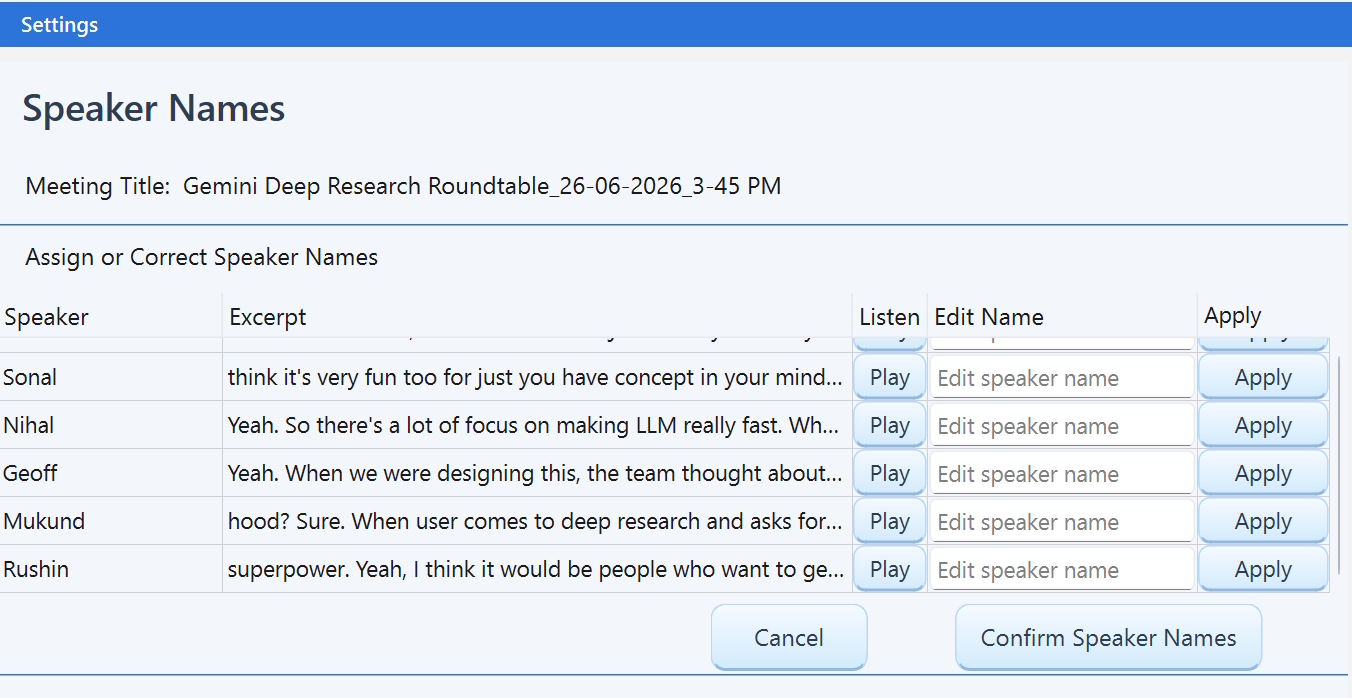
Figure 3: How AI-Transcript combines play audio with excerpt for better speaker identification
Why Speaker Identification Can Be Difficult
Microsoft Teams performs speaker diarisation exceptionally well under normal conditions.
Nevertheless, meetings often present situations that make accurate identification challenging.
These include:
-
participants joining from shared meeting rooms
-
poor microphone quality
-
background noise
-
similar sounding voices
-
participants joining late
-
participants leaving and rejoining
-
incomplete attendance information
-
overlapping speech
In some cases, Microsoft Teams may identify participants only as:
-
Speaker 1
-
Speaker 2
-
Speaker 3
In other situations, speaker names may be assigned incorrectly.
Neither situation prevents transcript creation.
However, both reduce confidence in the resulting Minutes of Meeting.
Speaker Verification in AI-Transcript
AI-Transcript provides moderators with dedicated tools for confirming speaker identities before detailed transcript review begins.
For every identified speaker, the system presents:
-
the current speaker name
-
representative transcript excerpts
-
short audio samples extracted from the original meeting recording
Listening to a short audio excerpt is often sufficient for moderators to recognise the participant immediately.
If necessary, the displayed speaker name can be updated.
Unlike manually editing dozens or hundreds of transcript entries, AI-Transcript performs this correction globally.
Every occurrence of that speaker throughout the transcript is updated consistently.
This saves considerable time while ensuring that the transcript remains internally consistent.
Why Audio Matters
People recognise voices remarkably well.
Often more accurately than names displayed on screen.
This is particularly valuable when:
-
anonymous speakers must be identified,
-
similar names exist,
-
participants changed devices during the meeting,
-
Microsoft Teams could not confidently determine speaker identity.
Rather than relying solely upon transcript text, moderators verify speaker identities using the original meeting audio.
This is another practical example of Dual Evidence Verification™.
The transcript provides one source of evidence.
The recording provides another.
Together they enable confident speaker verification.
Correcting Speaker Names
Correcting a speaker name is much more significant than changing a label.
It affects every downstream process.
Once verified, the speaker's identity becomes associated with:
-
decisions
-
action items
-
approvals
-
commitments
-
risks
-
questions
-
follow-up activities
Future searches can locate everything discussed by that participant.
Project managers can identify ownership more accurately.
Meeting minutes become substantially more reliable.
A seemingly simple correction therefore has lasting organisational value.
Beyond Speaker Names
Meetings rarely consist of ordinary conversational language.
Every organisation develops its own vocabulary.
Projects receive internal code names.
Customers are referred to by abbreviations.
Departments invent acronyms.
Technical teams use specialised terminology.
Product names evolve over time.
Although these expressions are perfectly familiar to employees, they frequently present difficulties for automatic speech recognition systems.
Consequently, technical terminology often becomes one of the largest sources of transcription inconsistency.
Organisational Language
Every organisation possesses its own linguistic fingerprint.
Examples include:
-
project names
-
customer names
-
internal systems
-
software products
-
engineering terminology
-
manufacturing processes
-
legal references
-
financial terminology
-
regulatory abbreviations
To someone outside the organisation, these words may appear meaningless.
To employees, they carry precise business meaning.
Artificial Intelligence performs significantly better when this terminology is recognised correctly.
For this reason, AI-Transcript dedicates an entire verification stage to organisational language.
AI Discovers Candidate Terms
During transcript analysis, AI identifies words and expressions that appear likely to represent:
-
technical terminology
-
company jargon
-
project names
-
product names
-
customer names
-
abbreviations
-
specialised vocabulary
Rather than automatically changing these terms, AI presents them to the moderator for review.
This preserves human control while dramatically reducing the effort required to identify terminology throughout lengthy meetings.
One Confirmation, Many Corrections
Suppose a meeting repeatedly refers to the project:
"Phoenix"
The transcript may contain several variations:
-
Phoenix
-
Fenix
-
Feenix
-
Phoenixx
Although humans recognise these as referring to the same project, AI cannot safely assume this without verification.
Once the moderator confirms the correct spelling, AI-Transcript updates every occurrence consistently throughout the transcript.
This ensures:
-
consistent terminology
-
improved readability
-
better searching
-
more reliable AI analysis
-
more accurate Minutes of Meeting
Why Terminology Matters to AI
Large Language Models rely heavily upon context.
Correct terminology significantly improves their ability to understand business discussions.
For example:
"The Orion deployment will be completed after Pegasus."
Without organisational context, Orion and Pegasus could refer to:
-
software
-
satellites
-
products
-
projects
-
customers
Once AI understands that both are internal migration projects, the sentence becomes immediately meaningful.
Providing AI with verified terminology therefore improves not only transcription quality but every subsequent stage of analysis.
Building an Organisational Vocabulary
One of the long-term advantages of AI-Transcript is that verified terminology does not need to be rediscovered in every meeting.
As organisations continue verifying transcripts, they gradually develop a growing repository of approved terminology.
This organisational vocabulary becomes increasingly valuable over time.
Future meetings benefit from:
-
previously verified project names
-
established customer names
-
approved abbreviations
-
technical expressions
-
industry terminology
Consequently, each verified meeting improves the analysis of future meetings.
This is one of the first stages in transforming isolated meetings into organisational intelligence.
Human Expertise Remains Essential
Artificial Intelligence can recognise patterns.
It cannot always determine official organisational terminology.
For example:
Should the transcript record:
"AI Transcript"
"AI-Transcript"
"AI Transcript™"
or
"AI-Transcript™"?
Only the organisation itself can decide.
Similarly, internal project names frequently evolve.
Employees naturally know which terminology is current.
Artificial Intelligence requires confirmation.
This illustrates once again the philosophy behind AI-Transcript.
AI identifies possibilities.
Humans establish certainty.
Preparing the Transcript for Collaborative Review
Once speaker identities and organisational terminology have been verified, the transcript reaches an important milestone.
Participants reviewing the meeting no longer encounter anonymous speakers or inconsistent terminology.
Instead, they see a transcript that already reflects:
-
verified participant identities,
-
consistent project names,
-
correct customer names,
-
standard organisational language.
This significantly improves the quality of participant feedback because reviewers can concentrate on understanding the discussion rather than interpreting inconsistent transcription.
Conclusion
Speaker verification and terminology verification may appear to be simple administrative tasks.
In reality, they establish the identity and language of the meeting.
Without them, actions cannot reliably be assigned, decisions cannot confidently be attributed, and technical discussions may be misunderstood.
By verifying who spoke and ensuring that organisational terminology is represented consistently, AI-Transcript creates a transcript that accurately reflects both the participants and the language of the organisation.
The methodology now moves from preparation to collaboration.
The next chapter introduces one of the defining features of AI-Transcript: Participant Review, where meeting attendees contribute their own knowledge, observations, and context to create a transcript that reflects not only what was said, but what was truly meant.
Chapter 8 - Phase 4 Participant Collaboration
Human Knowledge Completes Artificial Intelligence
Artificial Intelligence has transformed the way organisations record meetings.
It can recognise speech, identify speakers, summarise discussions, and even generate Minutes of Meeting within seconds.
Yet Artificial Intelligence has one important limitation.
It was not present during the meeting.
It cannot know:
-
what participants were thinking,
-
whether a statement was sarcastic,
-
which proposal everyone eventually accepted,
-
whether a technical term was used incorrectly,
-
whether a participant intended to make a commitment,
-
or whether everyone understood a decision in the same way.
Only the people who participated in the meeting possess this knowledge.
For this reason, AI-Transcript does not consider transcript verification to be the responsibility of Artificial Intelligence alone.
It is a collaborative process.
Artificial Intelligence identifies potential issues.
Meeting participants contribute their knowledge.
The moderator evaluates all evidence before approving the official transcript.
This combination creates a level of confidence that neither AI nor humans could achieve independently.
Why Participants Matter
Every meeting participant experiences the meeting from a different perspective.
A project manager focuses on delivery.
An engineer concentrates on technical discussions.
A finance representative listens for budgets and approvals.
A customer representative pays attention to commitments and expectations.
Although everyone attended the same meeting, each participant remembers different details.
Collectively, these perspectives create a far more complete understanding of the discussion than any single individual—or any AI model—could produce.
AI-Transcript harnesses this collective knowledge through a structured review process.
From Passive Readers to Active Contributors
In traditional meeting workflows, participants receive the Minutes of Meeting after they have already been written.
Their role is limited to reading the document and sending corrections by email.
This approach creates several problems.
Corrections become fragmented.
Different versions begin circulating.
Comments are easily overlooked.
The author must manually consolidate feedback.
There is rarely any clear record explaining why changes were made.
AI-Transcript replaces this unstructured process with collaborative verification.
Participants review the transcript itself rather than the finished Minutes of Meeting.
This allows issues to be resolved before meeting minutes are generated.
The result is a cleaner, more accurate, and more transparent workflow.
Reviewing the Transcript, Not the Minutes
This distinction is fundamental to the AI-Transcript methodology.
Participants are not reviewing the Minutes of Meeting.
They are reviewing the evidence from which those minutes will be created.
By improving the transcript first, every downstream AI-generated document benefits automatically.
These include:
-
Minutes of Meeting
-
Executive Summaries
-
Decision Registers
-
Action Lists
-
Project Reports
-
Knowledge Base Entries
One verified transcript supports many reliable outputs.
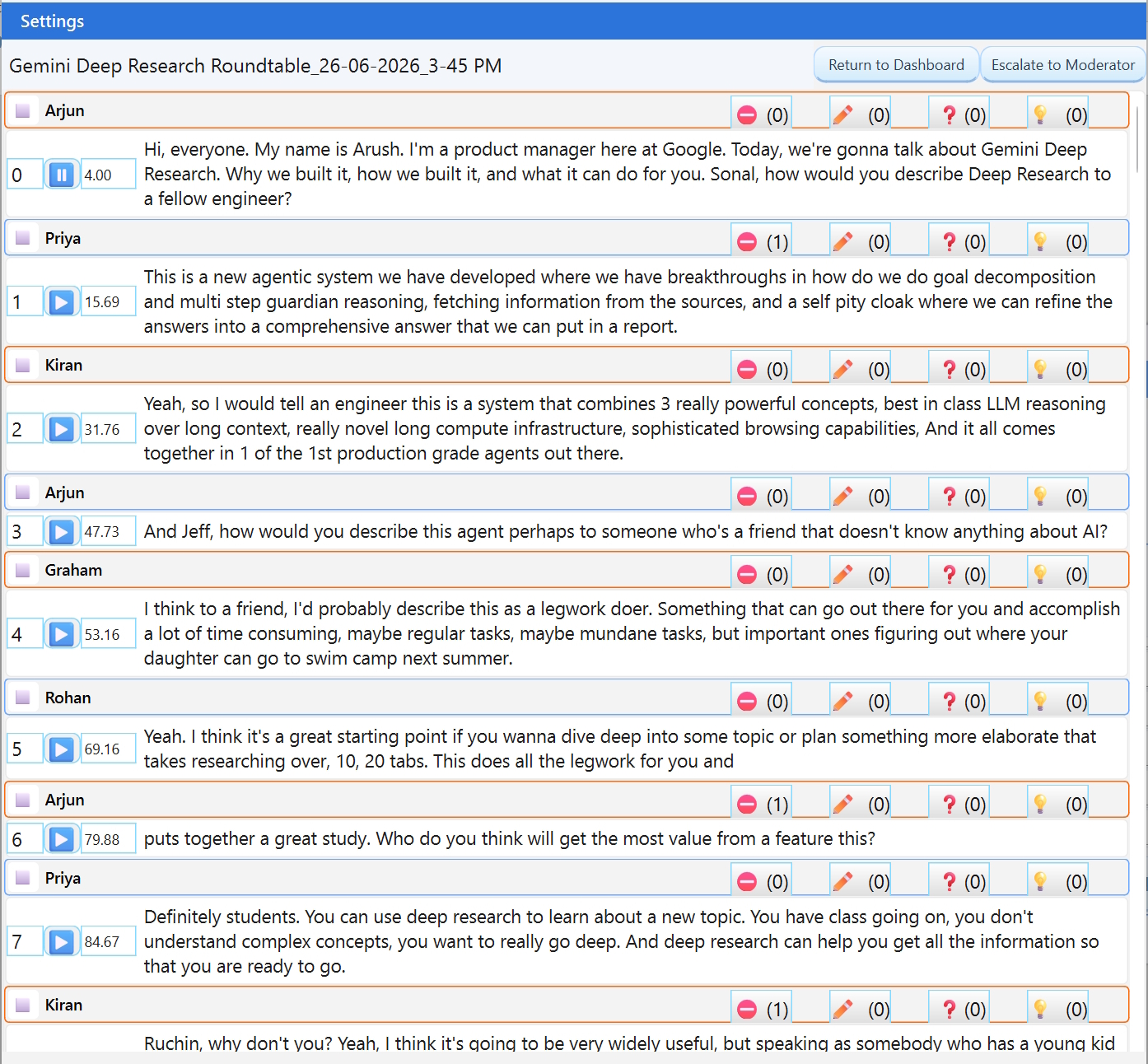
Figure 4: Screenshot of the AI-Transcript review screen, demonstrating how meeting participants compare written transcript text with its corresponding audio segment
A Structured Review Process
Rather than allowing unrestricted editing, AI-Transcript provides participants with a structured framework for submitting observations.
Every comment relates to a specific transcript segment.
Every observation is categorised.
Every contribution becomes traceable.
This structure ensures that comments remain organised, searchable, and easy for moderators to evaluate.
Instead of asking participants:
"Please review the transcript."
AI-Transcript asks much more focused questions.
For example:
-
Is this statement correct?
-
Does this decision require clarification?
-
Is the speaker correctly identified?
-
Is important context missing?
-
Should this discussion produce an action item?
Focused questions produce focused answers.
Four Types of Participant Feedback
AI-Transcript organises participant observations into four clearly defined categories.
This ensures that moderators immediately understand the purpose of each comment.
1. Transcript Blockers ⛔
Blockers identify issues that prevent reliable Minutes of Meeting from being created.
These are the highest-priority observations.
Typical examples include:
-
incorrect transcription
-
unknown speaker
-
missing decision
-
missing action owner
-
missing deadline
-
conflicting statements
A blocker indicates that an important part of the meeting cannot yet be interpreted with confidence.
These issues should normally be resolved before transcript approval.
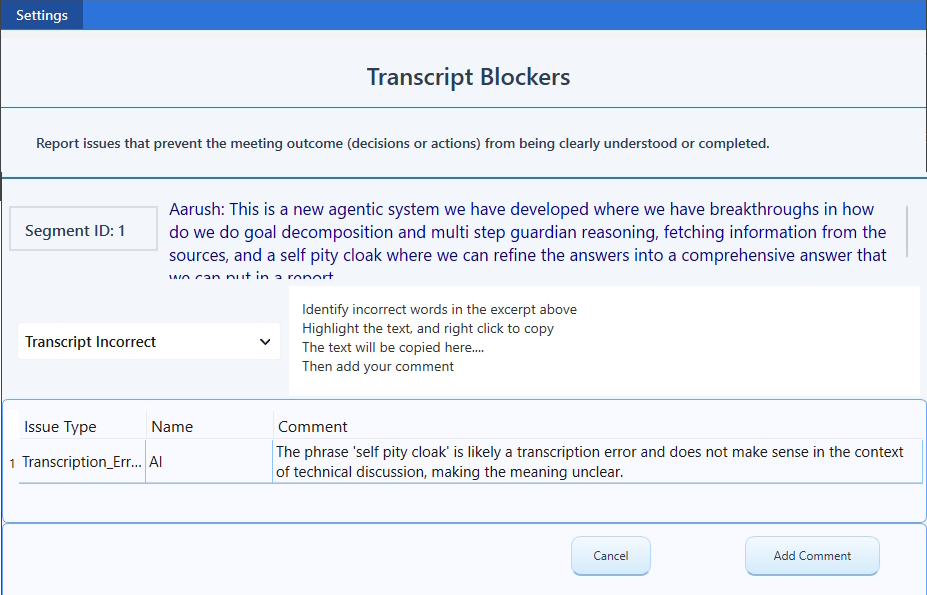
Figure 5: Blockers identify issues that prevent reliable Minutes of Meeting from being created
2. Corrections ✏️
Corrections identify objective transcription errors.
Typical examples include:
-
incorrect words
-
incorrect names
-
incorrect numbers
-
duplicated content
-
incorrect speaker assignment
Corrections improve factual accuracy without changing the meaning of the meeting.
They answer the question:
"What was actually said?"
3. Clarifications ❓
Clarifications provide additional understanding where the transcript alone may be insufficient.
Examples include:
-
ambiguous wording
-
missing business context
-
undefined acronyms
-
unclear references
-
incomplete explanations
Clarifications answer a different question:
"What did the participants mean?"
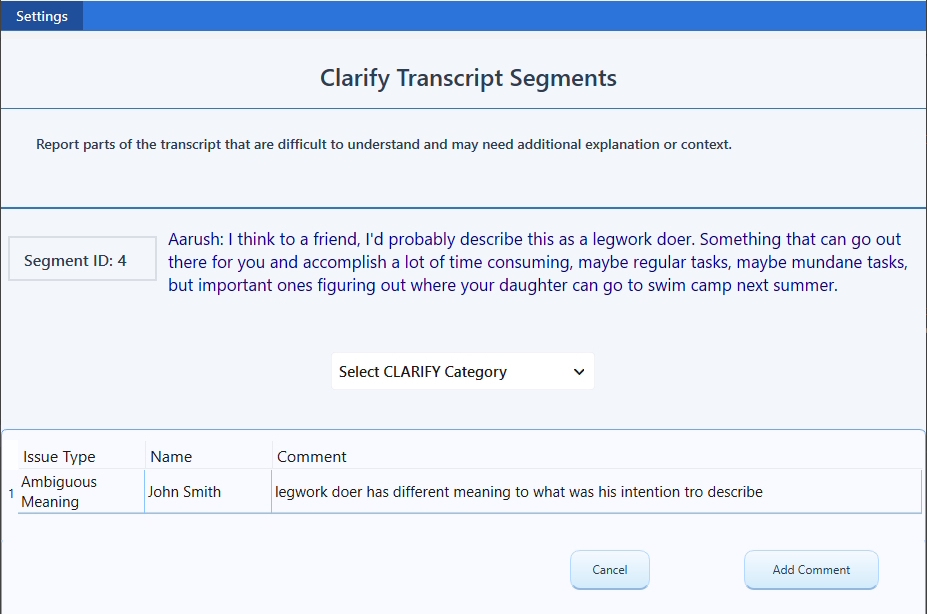
Figure 6: Clarifications provide additional understanding where the transcript alone may be insufficient.
4. Suggestions 💡
Suggestions improve the usefulness of the final meeting record.
Examples include:
-
identify an overlooked decision
-
extract an action item
-
highlight an important risk
-
merge related discussion
-
split unrelated topics
Suggestions do not necessarily indicate errors.
Instead, they enhance the quality of future AI-generated outputs.
Comments Are Not Transcript Changes
One of the most important principles of AI-Transcript is that participant comments never modify the transcript directly.
This protects the integrity of the original meeting record.
Participants contribute observations.
The moderator determines whether those observations should result in:
-
a transcript correction,
-
an annotation,
-
additional clarification,
-
or no change at all.
This distinction preserves accountability while encouraging open participation.
Every Comment Has an Author
Each participant comment is permanently associated with the person who submitted it.
This provides several important benefits.
Transparency.
Accountability.
Traceability.
If the moderator requires additional information, the contributor can be contacted directly.
Future reviewers can also understand why particular changes were proposed.
The verification process therefore becomes fully auditable.
Encouraging Constructive Collaboration
The objective of participant review is not to criticise the transcript.
Nor is it to criticise Artificial Intelligence.
Instead, participants are invited to improve the quality of the meeting record through collaborative knowledge sharing.
For this reason, AI-Transcript encourages reviewers to focus on:
-
facts rather than opinions,
-
clarification rather than criticism,
-
evidence rather than assumptions.
This creates a positive review culture in which participants collectively improve the quality of organisational knowledge.
A Practical Example
Consider the following transcript excerpt.
John: "We'll complete the migration before the customer audit."
A project engineer submits a clarification:
"The customer audit refers to the ISO 27001 compliance review scheduled for 14 September."
A project manager adds a suggestion:
"Create an action item assigning the migration to the Infrastructure Team."
A business analyst reports a correction:
"Migration should be 'database migration', not 'server migration'."
None of these comments modifies the transcript immediately.
Instead, they provide the moderator with additional evidence for making an informed decision.
When combined, these contributions create a significantly richer and more accurate meeting record than AI alone could produce.
Collaboration Improves Artificial Intelligence
An often-overlooked benefit of participant collaboration is that it improves future AI analysis.
Each verified correction contributes to:
-
more consistent terminology,
-
better understanding of organisational language,
-
improved project references,
-
clearer decision structures,
-
more reliable action extraction.
Over time, the organisation develops increasingly accurate verified meeting data.
Artificial Intelligence benefits because it analyses better information.
The organisation benefits because its knowledge base becomes progressively more reliable.
Shared Responsibility
Creating trustworthy Minutes of Meeting should never be the responsibility of one individual.
AI identifies potential issues.
Participants contribute their expertise.
Moderators evaluate the evidence.
Together they establish the official meeting record.
This distribution of responsibility significantly reduces the likelihood that important information will be overlooked.
It also builds confidence among participants because everyone has had an opportunity to contribute before the transcript is approved.
Collaboration Builds Trust
Trust is rarely achieved through automation alone.
People trust information when they know:
-
it has been reviewed,
-
multiple perspectives have been considered,
-
disagreements have been resolved,
-
evidence remains available,
-
decisions are transparent.
Participant collaboration transforms transcript verification from an individual task into a governed organisational process.
The transcript no longer represents the opinion of one person—or one AI model.
It represents the collective understanding of the meeting participants, validated by a moderator and supported by the original meeting recording.
Conclusion
Participant collaboration is one of the defining characteristics of the AI-Transcript methodology.
Rather than treating attendees as passive recipients of meeting minutes, AI-Transcript recognises them as valuable contributors to the quality of the organisational record.
By providing structured, traceable, and evidence-based collaboration, the platform captures knowledge that Artificial Intelligence alone cannot infer.
The result is a transcript that reflects not only the words spoken during the meeting, but the shared understanding of the people who were there.
With participant review complete, the verification process moves to its most important stage: Moderator Review and Transcript Verification, where all AI findings and participant contributions are evaluated to produce the organisation's official, verified meeting record.
Chapter 9 - Phase 5 Moderator Review and Transcript Verification
The Moderator: Guardian of the Official Meeting Record
Every successful verification process requires a final decision-maker.
Artificial Intelligence can identify potential issues.
Meeting participants can contribute valuable insights.
However, neither should determine the official record of an organisational meeting.
That responsibility belongs to the Moderator.
Within the AI-Transcript methodology, the Moderator is not simply another reviewer.
The Moderator is the custodian of the verified transcript and the final authority responsible for ensuring that the meeting record accurately reflects what was discussed, agreed, and committed during the meeting.
While AI provides analysis and participants provide knowledge, the Moderator provides judgement.
This distinction is fundamental to producing Minutes of Meeting that organisations can trust.
Why a Moderator Is Essential
Consider a meeting attended by ten people.
During transcript review:
-
one participant believes a decision was made,
-
another believes it was only discussed,
-
AI identifies a possible action item,
-
a third participant suggests additional context,
-
a fourth believes the transcript contains an error.
Who decides?
Without a structured approval process, multiple versions of the "truth" begin to emerge.
The transcript becomes a collection of opinions rather than an authoritative business record.
The Moderator resolves this problem.
Every observation is evaluated.
Every proposed change is considered.
Every decision is supported by evidence.
Only then is the transcript approved.
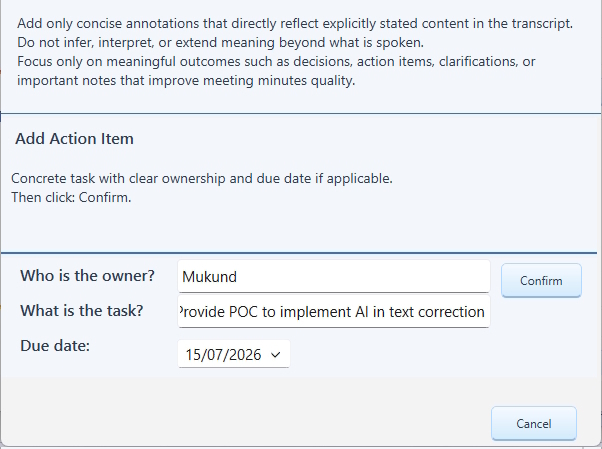
Figure 7: AI-only tools missing vital commitments and ruining official meeting records.
A Different Kind of Editing
Traditional document editing allows multiple people to modify text directly.
AI-Transcript deliberately avoids this approach.
The transcript represents historical evidence.
Historical evidence should not be freely rewritten.
Instead, AI-Transcript separates review from approval.
Participants submit observations.
Artificial Intelligence identifies issues.
The Moderator evaluates both before deciding whether the official transcript should change.
This preserves the integrity of the original meeting while ensuring that improvements remain evidence-based.
A Focused Review Environment
One of the challenges of reviewing long meeting transcripts is volume.
A two-hour meeting may contain more than a thousand transcript segments.
Reading every line repeatedly is both inefficient and unnecessary.
AI-Transcript therefore presents the Moderator with a focused review environment.
Rather than displaying the entire transcript, the Moderator primarily sees only the segments that require attention.
These are known as Issues.
Each issue has already been identified either by Artificial Intelligence or by meeting participants.
This approach allows the Moderator to concentrate on uncertainty rather than repeatedly reviewing information that has already been accepted.
The Issue Queue
The Moderator works through issues one at a time.
Each issue contains:
-
the transcript segment
-
speaker information
-
surrounding transcript context
-
participant comments
-
AI observations
-
issue category
-
audio playback
-
proposed corrections (where applicable)
This structured presentation enables informed decisions without requiring the Moderator to search manually through the transcript.
The process is systematic, repeatable, and efficient.
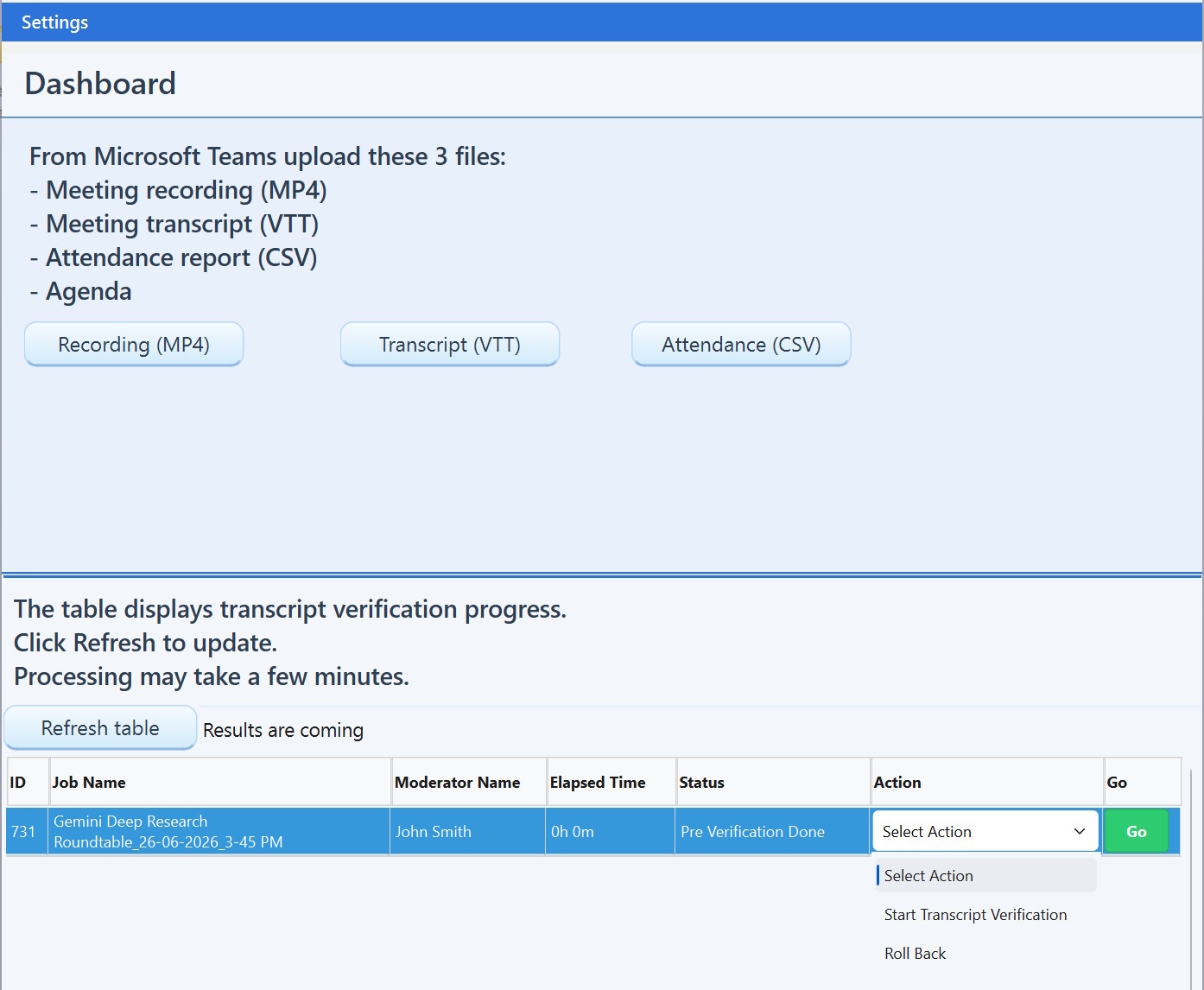
Figure 8: Managing transcripts queue
Four Sources of Evidence
Every moderator decision is based upon evidence rather than assumption.
Typically, the Moderator considers four complementary sources.
1. The Transcript
The recognised text provides the starting point for every review.
It represents the initial interpretation of the meeting produced by Microsoft's speech recognition technology.
2. The Original Audio
The Moderator can immediately replay the corresponding section of the meeting recording.
Listening to the original conversation often resolves uncertainty that reading alone cannot.
This is especially valuable when reviewing:
-
overlapping conversations,
-
uncertain terminology,
-
speaker identification,
-
disputed wording.
3. Participant Comments
Meeting participants provide valuable business context.
They explain terminology.
Clarify intent.
Identify overlooked commitments.
Correct transcription mistakes.
These observations provide insight that AI cannot infer independently.
4. Artificial Intelligence
AI contributes an additional analytical perspective.
It identifies:
-
possible inconsistencies,
-
missing information,
-
ambiguous statements,
-
potential decisions,
-
possible actions.
The Moderator evaluates these observations alongside all other available evidence.
Reviewing Issues
Each issue presented to the Moderator belongs to one of the four verification categories introduced earlier.
These categories help prioritise review.
Blockers generally require immediate attention because they may prevent reliable Minutes of Meeting from being created.
Corrections improve factual accuracy.
Clarifications improve understanding.
Suggestions enhance the usefulness of the final meeting record.
By reviewing issues category by category, Moderators can work systematically without overlooking important observations.
Corrections versus Annotations
One of the Moderator's most important responsibilities is deciding how information should be incorporated into the transcript.
Not every issue should result in editing the original transcript.
AI-Transcript therefore distinguishes between two different approaches.
Transcript Corrections
Corrections modify the transcript because something is objectively incorrect.
Examples include:
-
incorrect speaker names,
-
transcription mistakes,
-
incorrect terminology,
-
incorrect numbers,
-
duplicated text.
Corrections improve factual accuracy.
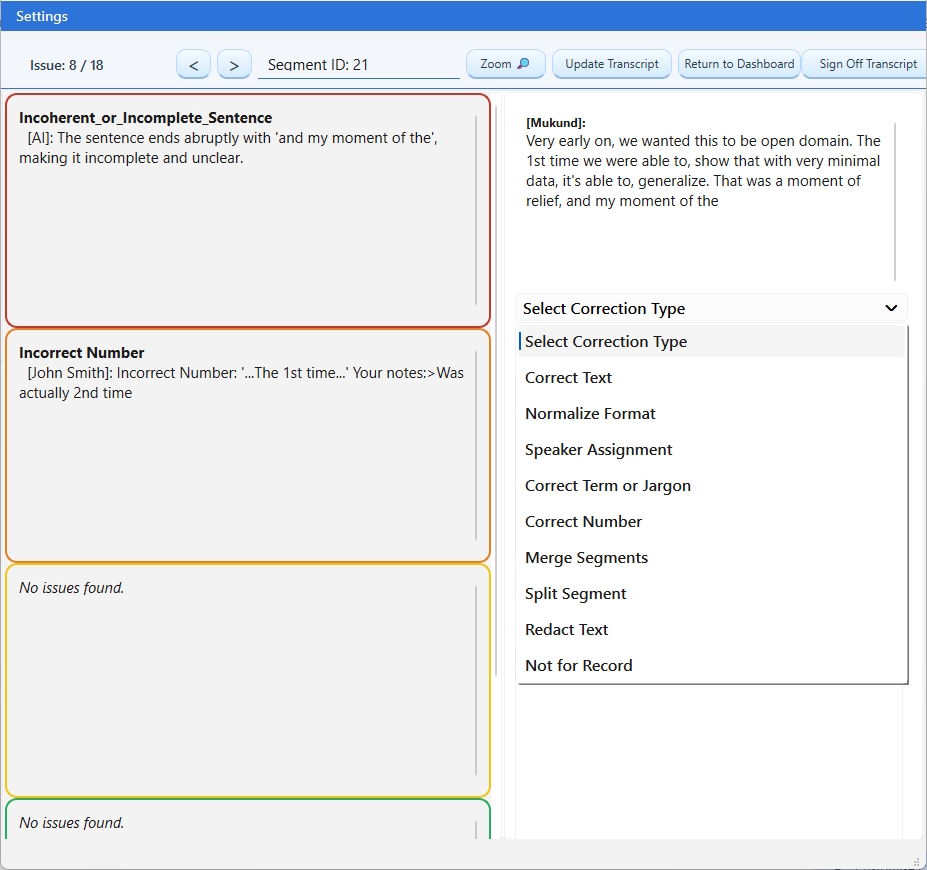
Figure 9: Corrections modify the transcript because something is objectively incorrect
Transcript Annotations
Annotations preserve the original transcript while adding valuable business information.
Examples include:
-
explanation of technical terminology,
-
additional meeting context,
-
recording a formal decision,
-
identifying business risks,
-
documenting assumptions.
Annotations enrich the transcript without changing what participants originally said.
This distinction is particularly important in regulated environments where preserving historical evidence is essential.
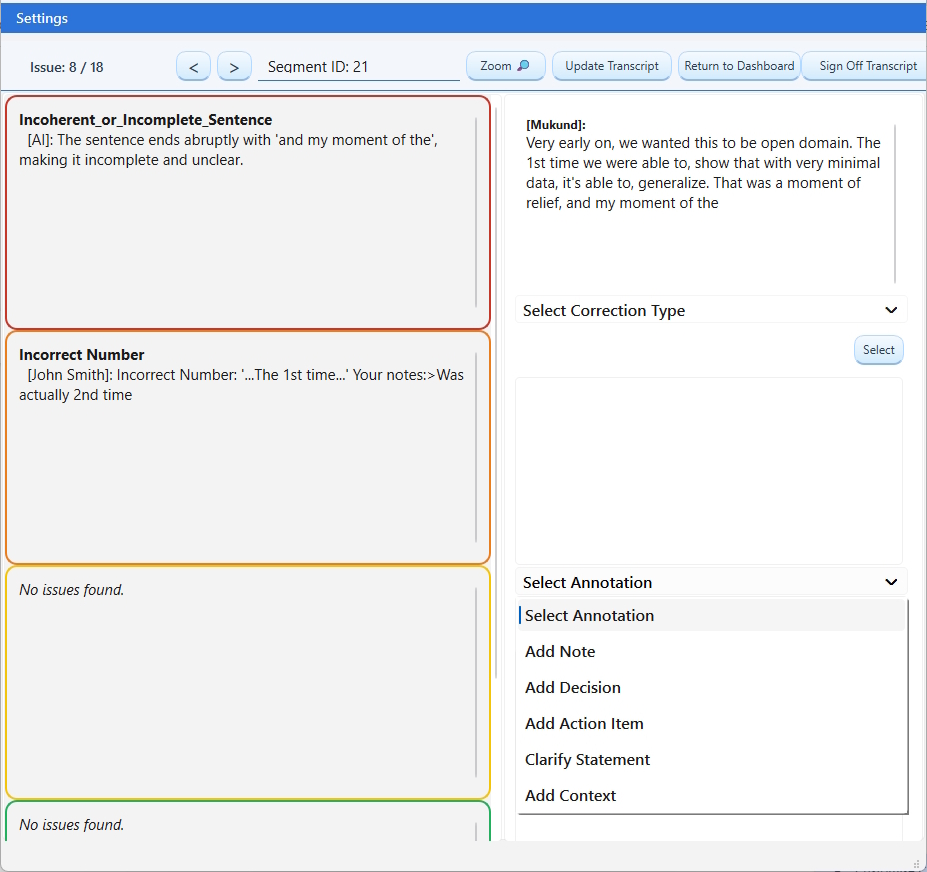
Figure 10: Annotations preserve the original transcript while adding valuable business information.
The Importance of Context
Every transcript segment exists within a broader conversation.
Reviewing one sentence in isolation can easily lead to incorrect conclusions.
For this reason, AI-Transcript provides contextual navigation.
The Moderator can immediately display transcript segments before and after the selected issue.
By expanding or reducing the surrounding context, the Moderator gains a better understanding of how the discussion developed.
Often, uncertainty disappears once the surrounding conversation is reviewed.
Zooming Into the Discussion
Some discussions require greater detail.
AI-Transcript includes a Zoom function that expands the selected issue into a focused review window.
Rather than displaying only the affected transcript segment, the Zoom view presents a larger portion of the surrounding conversation.
The Moderator can adjust how much context is displayed before and after the issue.
For example:
-
one preceding segment,
-
five preceding segments,
-
or several minutes of discussion.
Each transcript segment within this expanded view includes direct audio playback.
This allows the Moderator to follow the discussion naturally while comparing text with speech.
The result is a far more informed review than reading isolated transcript excerpts.
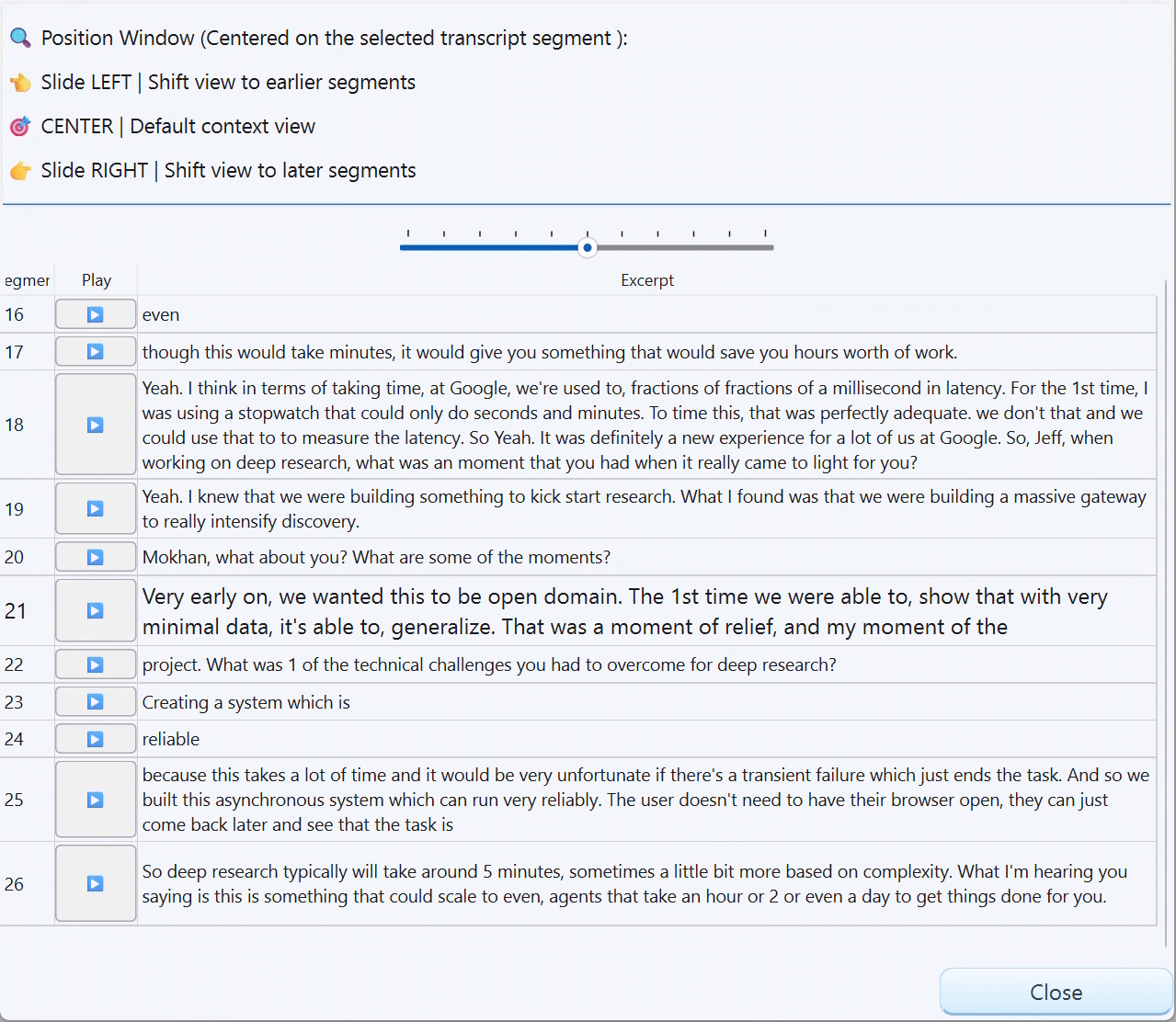
Figure 11: Screenshot of the AI-Transcript Zoom view expanding a discussion segment with surrounding context.
Human Judgement Cannot Be Automated
Artificial Intelligence can identify potential issues.
It cannot determine organisational intent.
For example:
A participant says:
"Let's investigate this further."
Did they:
-
assign an action?
-
make a recommendation?
-
postpone the decision?
-
simply express an opinion?
Only someone familiar with the discussion can decide.
The Moderator applies this judgement.
This illustrates an important principle of AI-Transcript:
Artificial Intelligence assists.
The Moderator decides.
Consistency Across the Entire Transcript
Every moderator decision has consequences beyond the immediate transcript segment.
Correcting a project name improves every future reference.
Confirming a speaker identity updates the transcript consistently.
Clarifying a technical term improves AI understanding throughout the meeting.
The Moderator therefore improves not merely individual transcript lines but the consistency of the entire meeting record.
Approving the Verified Transcript
Eventually, every issue reaches one of three outcomes.
It is:
-
accepted,
-
modified,
-
or dismissed.
Once all significant issues have been reviewed, the transcript is ready for approval.
Signing off the transcript confirms that:
-
all major issues have been evaluated,
-
speaker identities have been verified,
-
terminology has been standardised,
-
participant feedback has been considered,
-
corrections have been applied appropriately,
-
annotations accurately reflect additional business knowledge.
The transcript now becomes the organisation's verified version of the meeting.
It forms the foundation for every subsequent AI-generated output.
Governance Through Accountability
The Moderator plays a governance role rather than merely an editorial role.
Every approval contributes to:
-
organisational accountability,
-
consistent meeting records,
-
improved compliance,
-
stronger audit capability,
-
more reliable knowledge management.
Instead of relying upon an automatically generated transcript, the organisation now possesses a meeting record that has been reviewed, evaluated, and formally approved.
This distinction is one of the defining characteristics of AI-Transcript.
Conclusion
The Moderator is the final link between Artificial Intelligence and organisational trust.
By combining AI analysis, participant knowledge, transcript evidence, and original meeting audio, the Moderator transforms an automatically generated transcript into a verified organisational record.
This approval process does more than improve accuracy.
It establishes confidence.
Confidence that decisions are recorded correctly.
Confidence that actions have been assigned appropriately.
Confidence that future readers can rely upon the meeting record.
Only after this stage is complete does AI-Transcript generate the final Minutes of Meeting, knowing that they are based on information that has already earned the organisation's trust.
Chapter 10 - Phase 6 Transcript Approval and Sign-off
When a Transcript Becomes an Official Record
Throughout the previous chapters, the transcript has evolved through multiple stages of review.
Artificial Intelligence has analysed its quality.
Speaker identities have been verified.
Organisational terminology has been standardised.
Meeting participants have contributed their observations.
The Moderator has reviewed every significant issue and evaluated the available evidence.
The transcript is now approaching its final stage.
This stage is known as Transcript Approval and Sign-off.
Although the sign-off process requires only a single action from the Moderator, its significance extends far beyond pressing a button.
Transcript approval represents the point at which a working document becomes an official organisational record.
Why Sign-off Matters
During transcript verification, the document remains a work in progress.
Issues may still be unresolved.
Comments may still be under review.
Participants may continue contributing observations.
Artificial Intelligence may continue identifying possible improvements.
At this stage, the transcript should not yet be considered the definitive record of the meeting.
Sign-off changes that.
Once approved, the organisation recognises the transcript as the verified representation of the meeting discussion.
Subsequent AI-generated outputs—including Minutes of Meeting, action registers, and decision logs—are produced from this verified version rather than from the original unverified transcript.
The distinction is fundamental.
The organisation no longer relies upon automatically recognised speech.
It relies upon information that has been reviewed, verified, and formally approved.
What Does the Moderator Confirm?
By approving the transcript, the Moderator confirms that reasonable verification has been completed.
This does not imply that every spoken word has been examined individually.
Instead, it confirms that the transcript has been reviewed sufficiently to support reliable organisational use.
The Moderator confirms that:
-
Speaker identities have been verified where necessary.
-
Technical terminology has been reviewed and standardised.
-
Significant transcription errors have been corrected.
-
Participant feedback has been evaluated.
-
Critical ambiguities have been resolved or appropriately annotated.
-
Decisions, actions, owners, and deadlines are represented accurately to the best of the available evidence.
The emphasis is not on achieving perfection.
It is on establishing confidence.
Sign-off Is a Governance Decision
Many software applications use the term Approve to indicate that a document has been reviewed.
Within AI-Transcript, sign-off carries greater organisational significance.
Approval represents a governance decision.
It records that an authorised individual accepts responsibility for the transcript as the organisation's official record of the meeting.
This distinction becomes particularly important when meeting records support:
-
contractual obligations,
-
regulatory reporting,
-
project governance,
-
compliance activities,
-
quality management systems,
-
executive decision-making.
The approved transcript becomes part of the organisation's documentary evidence.
Version Control
Every important business document evolves over time.
Meeting transcripts are no exception.
AI-Transcript therefore distinguishes between:
Original Transcript
The transcript generated automatically by Microsoft Teams.
Working Transcript
The transcript undergoing verification.
Verified Transcript
The transcript that has been formally approved by the Moderator.
Maintaining these separate stages preserves transparency throughout the verification process.
The organisation can always distinguish between machine-generated content and verified organisational records.
Preserving History
An important principle of AI-Transcript is that verification should never erase history.
The original transcript remains preserved.
Participant comments remain available.
Moderator decisions remain traceable.
Corrections remain documented.
Annotations remain associated with the relevant transcript segments.
Rather than replacing historical information, AI-Transcript builds an auditable verification history.
This approach provides confidence that the approved transcript can always be explained, reviewed, or revisited if necessary.
Locking the Verified Transcript
Following sign-off, the verified transcript is typically protected from further modification.
This does not prevent future review.
Rather, it preserves the integrity of the approved meeting record.
If additional information later becomes available—for example, a participant identifies an overlooked issue—the organisation may choose to initiate a controlled revision rather than editing the approved transcript directly.
This approach mirrors the document control practices used in quality management systems, where approved records remain stable while subsequent revisions are separately managed.
From Transcript to Trusted Information
Approval marks an important transition.
Before sign-off, the transcript represents a working document.
After sign-off, it becomes trusted organisational information.
From this point onward, the transcript can confidently support:
-
Minutes of Meeting,
-
decision registers,
-
action tracking,
-
project documentation,
-
organisational knowledge repositories,
-
compliance evidence.
The quality of these outputs is directly influenced by the quality of the approved transcript.
For this reason, AI-Transcript delays document generation until verification has been completed.
Confidence Before Automation
One of the guiding principles of AI-Transcript is:
Confidence before automation.
Artificial Intelligence can generate documents in seconds.
However, generating documents quickly is of little value if the underlying information is unreliable.
AI-Transcript therefore invests effort in improving confidence before asking AI to produce business documents.
The result is not slower automation.
It is better automation.
Automation supported by verified information consistently produces higher-quality outcomes than automation based upon uncertain evidence.
The Foundation for Every Future Output
The approved transcript is not the end of the verification process.
It is the beginning of everything that follows.
Once verified, the transcript becomes the trusted source from which AI can reliably generate:
-
Minutes of Meeting
-
Executive summaries
-
Action registers
-
Decision logs
-
Risk registers
-
Follow-up reports
-
Project documentation
-
Organisational knowledge
Every future output inherits the quality of the verified transcript.
This is why transcript approval occupies such a central position within the AI-Transcript methodology.
Building Organisational Trust
Ultimately, transcript approval is not about software.
It is about organisational trust.
Employees need confidence that meeting records accurately reflect what was discussed.
Project managers need confidence that actions have been assigned correctly.
Executives need confidence that strategic decisions have been captured faithfully.
Compliance officers need confidence that meeting records can withstand external scrutiny.
The approval process provides that confidence by ensuring that the official record is based on evidence, collaboration, and informed judgement rather than on automation alone.
Conclusion
Transcript Approval and Sign-off represent the transition from verification to action.
At this point, the transcript ceases to be a draft under review and becomes the organisation's trusted account of the meeting.
Only after this milestone has been reached does AI-Transcript begin generating the business documents that organisations rely upon every day.
The next chapter explores this transformation in detail, explaining how a Verified Transcript becomes Verified Minutes of Meeting, along with action registers, decision logs, executive summaries, and other outputs that support effective business operations.
Chapter 11 - Generating Verified Minutes of Meeting
From Verified Evidence to Trusted Business Documents
The objective of AI-Transcript is not simply to produce a transcript.
Nor is it simply to generate meeting minutes.
Its objective is to create trusted business records.
By the time the transcript reaches the end of the verification process, it has undergone multiple levels of review.
Artificial Intelligence has analysed its quality.
Participants have contributed their knowledge.
The Moderator has evaluated the evidence.
Speaker identities have been confirmed.
Organisational terminology has been standardised.
Critical ambiguities have been resolved.
Only now does AI begin generating business documents.
This sequence is intentional.
Rather than asking Artificial Intelligence to interpret uncertain information, AI-Transcript asks it to analyse information that has already earned the organisation's confidence.
Why Verification Comes First
Many AI meeting applications generate meeting minutes immediately after transcription.
This produces impressive speed.
However, speed alone does not guarantee reliability.
If the transcript contains:
-
incorrect speaker identification,
-
missing context,
-
ambiguous statements,
-
transcription errors,
-
incomplete decisions,
then every AI-generated output inherits those weaknesses.
This principle is sometimes described as:
Garbage In, Garbage Out.
AI cannot consistently produce trustworthy business documents from uncertain evidence.
AI-Transcript reverses the sequence.
It improves the evidence first.
Only then does it automate document generation.
This approach significantly increases the reliability of every downstream output.
One Verified Transcript, Many Outputs
A verified transcript is much more than a corrected transcript.
It becomes the authoritative source from which multiple business documents can be produced.
Examples include:
-
Verified Minutes of Meeting
-
Executive Summary
-
Decision Register
-
Action Register
-
Risk Register
-
Follow-up Activities
-
Meeting Highlights
-
Customer Commitments
-
Project Status Updates
Rather than generating each document independently, AI-Transcript derives them from the same verified source.
This consistency ensures that all outputs tell the same story.
Verified Minutes of Meeting
Verified Minutes of Meeting provide a concise and reliable account of the meeting.
Rather than reproducing every spoken sentence, the minutes focus on the information that matters most.
Typical sections include:
-
Meeting purpose
-
Key discussion topics
-
Decisions made
-
Actions agreed
-
Action owners
-
Target dates
-
Risks and concerns
-
Outstanding questions
-
Next steps
Because these sections are generated from a verified transcript, they are substantially more reliable than minutes generated directly from an unverified transcript.
Decisions
One of the most valuable outputs of AI-Transcript is the extraction of meeting decisions.
Many meetings contain lengthy discussions before participants finally reach agreement.
Without verification, AI may incorrectly interpret a proposal as a decision.
For example:
"One option would be to migrate next month."
This is not a decision.
Later in the meeting, the participants conclude:
"We will complete the migration during the September maintenance window."
This is the decision.
Because the transcript has been verified, AI can distinguish between options that were discussed and decisions that were actually made.
This distinction is critical for effective governance and project management.
Action Register
Projects succeed when agreed actions are clearly recorded and tracked.
AI-Transcript automatically identifies action items from the verified transcript.
Each action typically includes:
-
description of the task,
-
responsible owner,
-
due date (if specified),
-
related discussion,
-
supporting transcript reference.
Where information remains incomplete, the transcript verification process usually identifies these gaps before the Action Register is generated.
As a result, project teams receive action lists that are clearer, more complete, and more reliable.
Executive Summary
Senior managers rarely need to read an entire meeting transcript.
They require a concise overview of the meeting.
AI-Transcript generates Executive Summaries that highlight:
-
meeting objectives,
-
major outcomes,
-
strategic decisions,
-
key risks,
-
significant follow-up activities.
Because the summary is derived from verified information, executives gain confidence that important business decisions have not been overlooked or misrepresented.
Risks and Issues
Meetings frequently identify risks that require ongoing monitoring.
Examples include:
-
project delays,
-
resource shortages,
-
technical constraints,
-
budget concerns,
-
customer issues,
-
compliance risks.
AI-Transcript identifies these discussions and presents them within a structured Risk Register.
Project managers can therefore review emerging risks without re-reading lengthy transcripts.
Traceability Back to the Evidence
Perhaps the greatest advantage of AI-Transcript is that every generated document remains connected to its source.
If a reader questions a particular action or decision, they can trace it back through:
-
the Verified Minutes of Meeting,
-
the verified transcript,
-
the transcript segment,
-
the original meeting audio.
This level of traceability is rarely available in traditional meeting documentation.
It creates confidence because every conclusion can be supported by evidence.
Consistency Across Documents
Traditional meeting documentation is often created manually.
Different people prepare different reports.
Different interpretations emerge.
Important information becomes inconsistent.
AI-Transcript eliminates much of this inconsistency.
Because all reports originate from the same verified transcript:
-
actions match decisions,
-
summaries match discussions,
-
reports match meeting minutes,
-
terminology remains consistent.
The organisation therefore works from one trusted version of the meeting.
Human Review Remains Valuable
Even after verification, AI-generated documents should still be reviewed before external distribution where appropriate.
AI-Transcript significantly reduces the effort required to produce reliable documents.
It does not eliminate professional judgement.
Organisations remain responsible for determining whether generated documents are appropriate for their intended audience and purpose.
This philosophy reflects AI-Transcript's broader approach:
Artificial Intelligence accelerates business processes.
People remain accountable for business decisions.
Beyond Meeting Minutes
Although Verified Minutes of Meeting are often the primary deliverable, they are only one expression of the verified transcript.
The same transcript can support:
-
project governance,
-
customer engagement,
-
operational reporting,
-
compliance documentation,
-
organisational learning,
-
strategic planning.
Every verified meeting therefore becomes a reusable organisational asset rather than a document that is read once and forgotten.
Measuring Success
The success of AI-Transcript should not be measured by:
-
the number of transcripts processed,
-
the speed of AI generation,
-
the length of meeting summaries.
Instead, success should be measured by questions such as:
-
Were the right decisions captured?
-
Were actions assigned correctly?
-
Did participants agree with the meeting record?
-
Can future readers trust the information?
-
Can the organisation confidently rely on these records months or years later?
These questions shift the focus from automation to trust.
That is the true purpose of transcript verification.
Conclusion
Generating business documents is one of the final stages of the AI-Transcript methodology, but it is not the most important stage.
The most important stage is ensuring that the information from which those documents are created is trustworthy.
By delaying automation until verification is complete, AI-Transcript enables Artificial Intelligence to produce meeting records that are not only efficient, but dependable.
The result is a suite of business documents built on verified evidence rather than unverified assumptions.
In the next chapter, we move beyond individual meetings to explore how verified transcripts accumulate over time, creating a searchable repository of organisational knowledge and forming the foundation of Organisational Intelligence—one of AI-Transcript's most powerful capabilities.
Chapter 12 - Organisational Intelligence
Every Verified Meeting Makes Your Organisation Smarter
Most meeting applications treat each meeting as an isolated event.
A transcript is generated.
Meeting minutes are created.
The meeting is over.
By the following week, another transcript is created and the previous meeting is largely forgotten.
AI-Transcript takes a different approach.
Each verified meeting becomes part of a growing body of organisational knowledge. Instead of existing as individual documents, verified transcripts are connected through Meeting Categories, allowing organisations to build a searchable history of projects, customers, products, and business activities.
From Meetings to Organisational Knowledge
A single meeting rarely tells the whole story.
Projects evolve over months.
Customer discussions continue over multiple meetings.
Decisions are revisited.
New risks emerge.
Actions are completed or reassigned.
When these meetings are linked together, they create a valuable knowledge base that records how decisions were made and how projects progressed.
AI-Transcript enables organisations to capture this history rather than losing it across hundreds of disconnected meeting files.
Meeting Categories
Meeting Categories are one of the key features of AI-Transcript.
A Meeting Category groups related meetings under a common business topic, such as:
-
Customer projects
-
Product development
-
Executive management
-
Risk and compliance
-
Sales opportunities
-
Steering committee meetings
Each new verified meeting automatically becomes part of that category, creating a chronological record of discussions and decisions.
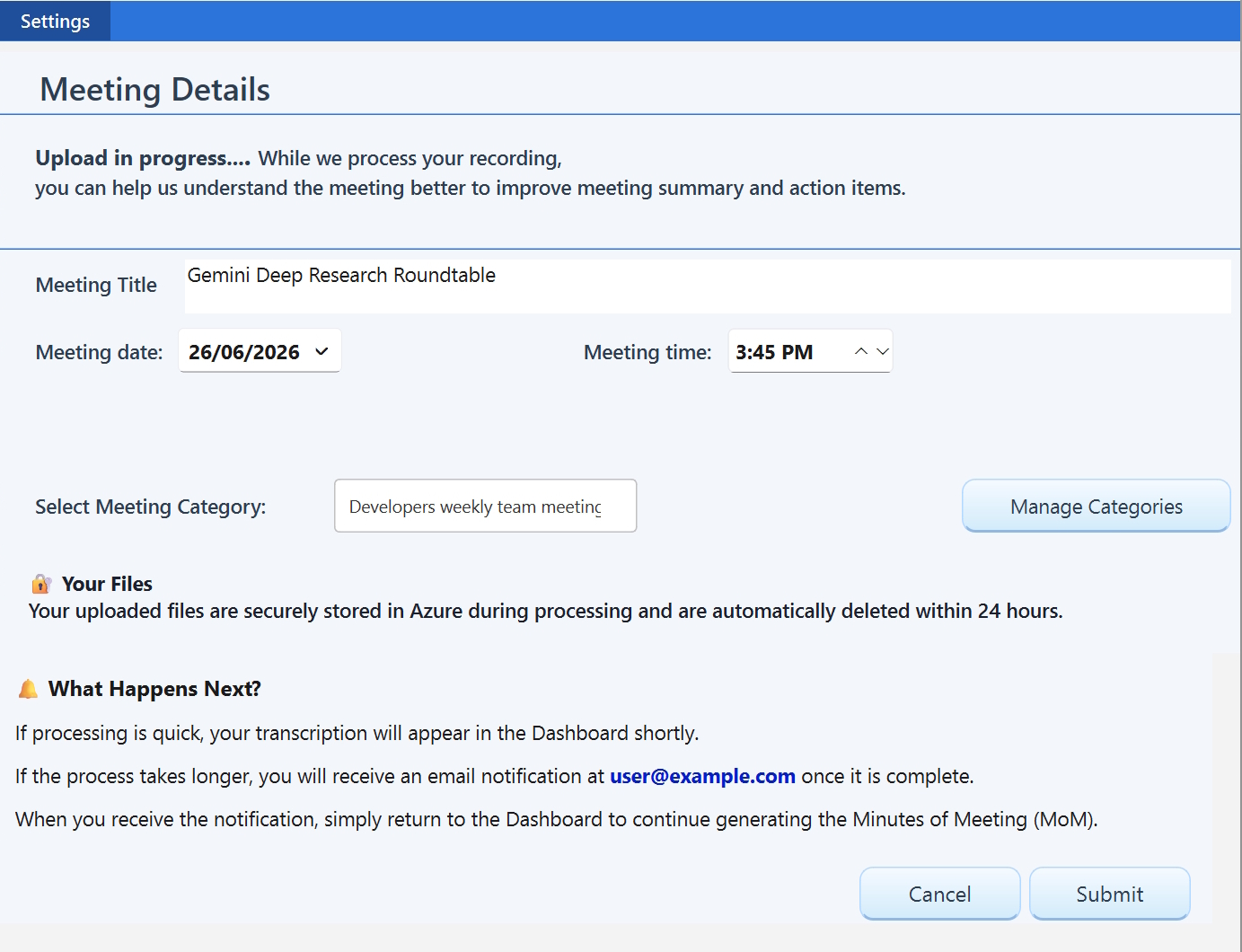
Figure 12: A Meeting Category groups related meetings under a common business topic
Finding Information Quickly
Instead of searching through folders or trying to remember when something was discussed, users can search across all verified meetings within a category.
Typical questions include:
-
When was this decision made?
-
Who agreed to this action?
-
Why was this requirement changed?
-
What risks were identified?
-
Has this issue been discussed before?
Because every transcript has been verified, the search results are far more reliable than searching unverified transcripts.
Better AI Through Better Data
Artificial Intelligence performs best when it has access to accurate and consistent information.
As more meetings are verified, AI-Transcript builds a richer understanding of:
-
company terminology
-
project names
-
customer names
-
recurring topics
-
organisational language
This improves the quality of future transcript analysis and document generation.
In other words, every verified meeting helps improve the next one.
Supporting Business Continuity
People change roles.
Projects are handed over.
New employees join existing teams.
Without reliable meeting records, valuable knowledge is often lost.
AI-Transcript helps preserve organisational knowledge by maintaining a searchable history of verified discussions, decisions, and actions.
New team members can quickly understand the background of a project without relying solely on personal handover notes or memory.
More Than Meeting Minutes
The true value of AI-Transcript is not the transcript itself.
It is the knowledge created from verified meetings.
Instead of producing documents that are read once and forgotten, AI-Transcript creates a growing repository of trusted organisational information that supports better decision-making over time.
Conclusion
Every organisation already holds thousands of meetings each year.
The challenge is not creating more meeting records—it is making those records useful.
By connecting verified transcripts into a structured knowledge base, AI-Transcript transforms everyday meetings into lasting organisational intelligence.
Every verified meeting becomes another trusted piece of knowledge that can support future projects, improve decision-making, and preserve corporate memory.
Chapter 13 - Best Practices and Final Thoughts
Building Trust Through Transcript Verification
AI-Transcript has been designed around a simple principle:
Artificial Intelligence should assist people in creating trusted meeting records—not replace human judgement.
The methodology described throughout this guide combines the speed of AI with the experience of meeting participants and the judgement of a moderator. The result is a verification process that produces meeting records organisations can rely on with confidence.
The following recommendations will help you obtain the best results from AI-Transcript.
1. Upload the Complete Meeting Evidence
Whenever possible, include all available meeting information:
-
Microsoft Teams transcript
-
Meeting recording
-
Meeting agenda
-
Attendance report
-
Supporting documents
Additional context enables AI to better understand the discussion and reduces ambiguity during verification.
2. Verify Speaker Identities Early
Correct speaker identification is fundamental to reliable meeting records.
Before reviewing transcript content, confirm that speakers have been correctly identified. This ensures that decisions, commitments, and action items are attributed to the correct participants.
3. Encourage Participant Review
Meeting participants possess knowledge that AI cannot infer.
Encourage attendees to review the transcript and contribute comments, corrections, and clarifications while the meeting is still fresh in their minds.
Early collaboration improves both accuracy and efficiency.
4. Resolve Important Issues First
Not every transcript issue has the same impact.
Prioritise:
-
Missing decisions
-
Missing action owners
-
Missing deadlines
-
Incorrect speaker identification
-
Significant transcription errors
Resolving these issues first provides the greatest improvement in transcript quality.
5. Use the Original Recording When Needed
When uncertainty exists, listen to the original meeting recording.
The combination of transcript and audio provides the strongest evidence for making informed verification decisions.
6. Preserve Context
Avoid reviewing transcript excerpts in isolation.
Always consider the surrounding discussion before making corrections or interpreting participant intent.
Context often explains statements that might otherwise appear ambiguous.
7. Generate Minutes Only After Verification
AI can generate meeting minutes at any stage.
However, the highest-quality Minutes of Meeting are produced only after transcript verification has been completed.
Verified transcripts produce more reliable summaries, decisions, actions, and executive reports.
The Long-Term Value
The immediate benefit of AI-Transcript is improved meeting documentation.
The long-term benefit is far greater.
Every verified meeting contributes to a growing repository of trusted organisational knowledge.
Over time, organisations build:
-
Consistent meeting records
-
Reliable project history
-
Searchable decisions
-
Accurate action tracking
-
Improved organisational memory
This knowledge remains valuable long after the meeting has ended.
Looking Ahead
Artificial Intelligence will continue to improve.
Speech recognition will become more accurate.
Large Language Models will become more capable.
Meeting summaries will become increasingly sophisticated.
Yet one requirement will remain unchanged:
Organisations must be able to trust the records upon which they make business decisions.
That trust cannot be achieved through automation alone.
It requires verification.
Final Thoughts
AI-Transcript introduces a practical methodology that combines Artificial Intelligence with human expertise to produce meeting records that are accurate, transparent, and trustworthy.
Rather than replacing people, AI-Transcript empowers them by reducing repetitive work, highlighting potential issues, and providing the tools needed to verify meeting content efficiently.
The result is more than a transcript.
It is more than a set of meeting minutes.
It is a trusted record of organisational knowledge.
Key Takeaways
As you begin using AI-Transcript, remember these principles:
-
AI accelerates the verification process.
-
People provide the knowledge and judgement.
-
Moderators establish the official record.
-
Verified transcripts produce better business documents.
-
Every verified meeting strengthens organisational knowledge.
Conclusion
Every meeting contains information that influences future decisions, projects, and relationships.
By verifying transcripts before generating business documents, organisations gain greater confidence in the information they retain and the decisions they make.
AI-Transcript is more than a meeting application. It provides a structured approach to transcript verification that transforms Microsoft Teams transcripts into trusted organisational records and lasting organisational knowledge.
As your organisation verifies more meetings, the value continues to grow—meeting by meeting, project by project, building a knowledge base that supports better decisions well into the future.
Disclaimer:
The transcript used in this demonstration originates from a publicly available YouTube video.
All verification results, annotations, and screenshots are produced by AI-Transcript.