Chapter 7 - Phase 3 Verifying Speakers and Organisational Terminology
Knowing Who Said What
One of the most important questions arising from any meeting is surprisingly simple:
Who said it?
The answer determines much more than the flow of a conversation.
It establishes accountability.
It identifies decision makers.
It assigns ownership of actions.
It records commitments.
It documents approvals.
Without reliable speaker identification, even a perfectly transcribed sentence may become misleading.
For this reason, speaker verification is one of the earliest stages of the AI-Transcript methodology.
Before participants begin reviewing the content of the meeting, the identities of the speakers must first be confirmed.
Only then can the transcript become a dependable foundation for trustworthy Minutes of Meeting.
Why Speaker Identification Matters
Consider the following transcript excerpt.
Speaker 3: "I'll prepare the revised proposal by Friday."
The statement appears clear.
However, one essential question remains unanswered.
Who is Speaker 3?
If the speaker's identity is unknown, the resulting action item cannot be assigned correctly.
Now consider a second example.
John: "I'll prepare the revised proposal by Friday."
The meaning has immediately become complete.
The action now has:
-
an owner
-
a commitment
-
accountability
-
traceability
A single piece of information—the speaker's identity—transforms an anonymous statement into an actionable business commitment.
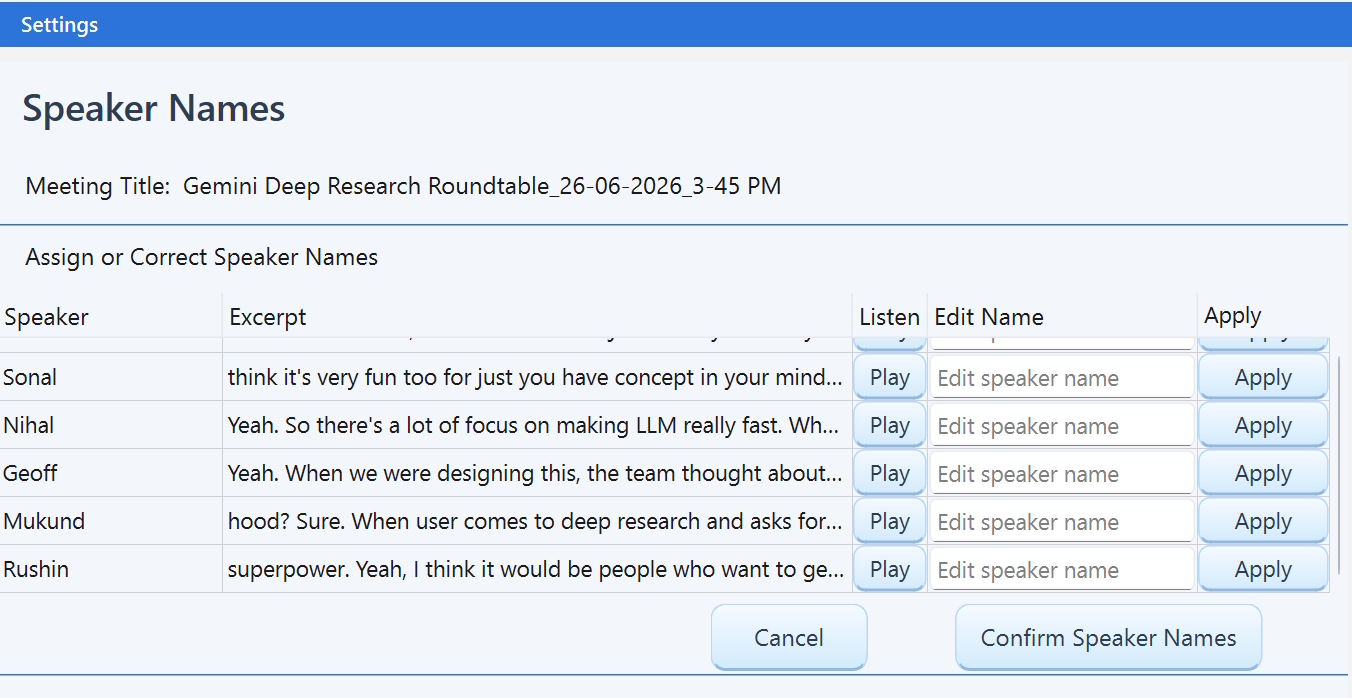
Figure 3: How AI-Transcript combines play audio with excerpt for better speaker identification
Why Speaker Identification Can Be Difficult
Microsoft Teams performs speaker diarisation exceptionally well under normal conditions.
Nevertheless, meetings often present situations that make accurate identification challenging.
These include:
-
participants joining from shared meeting rooms
-
poor microphone quality
-
background noise
-
similar sounding voices
-
participants joining late
-
participants leaving and rejoining
-
incomplete attendance information
-
overlapping speech
In some cases, Microsoft Teams may identify participants only as:
-
Speaker 1
-
Speaker 2
-
Speaker 3
In other situations, speaker names may be assigned incorrectly.
Neither situation prevents transcript creation.
However, both reduce confidence in the resulting Minutes of Meeting.
Speaker Verification in AI-Transcript
AI-Transcript provides moderators with dedicated tools for confirming speaker identities before detailed transcript review begins.
For every identified speaker, the system presents:
-
the current speaker name
-
representative transcript excerpts
-
short audio samples extracted from the original meeting recording
Listening to a short audio excerpt is often sufficient for moderators to recognise the participant immediately.
If necessary, the displayed speaker name can be updated.
Unlike manually editing dozens or hundreds of transcript entries, AI-Transcript performs this correction globally.
Every occurrence of that speaker throughout the transcript is updated consistently.
This saves considerable time while ensuring that the transcript remains internally consistent.
Why Audio Matters
People recognise voices remarkably well.
Often more accurately than names displayed on screen.
This is particularly valuable when:
-
anonymous speakers must be identified,
-
similar names exist,
-
participants changed devices during the meeting,
-
Microsoft Teams could not confidently determine speaker identity.
Rather than relying solely upon transcript text, moderators verify speaker identities using the original meeting audio.
This is another practical example of Dual Evidence Verificationâ„¢.
The transcript provides one source of evidence.
The recording provides another.
Together they enable confident speaker verification.
Correcting Speaker Names
Correcting a speaker name is much more significant than changing a label.
It affects every downstream process.
Once verified, the speaker's identity becomes associated with:
-
decisions
-
action items
-
approvals
-
commitments
-
risks
-
questions
-
follow-up activities
Future searches can locate everything discussed by that participant.
Project managers can identify ownership more accurately.
Meeting minutes become substantially more reliable.
A seemingly simple correction therefore has lasting organisational value.
Beyond Speaker Names
Meetings rarely consist of ordinary conversational language.
Every organisation develops its own vocabulary.
Projects receive internal code names.
Customers are referred to by abbreviations.
Departments invent acronyms.
Technical teams use specialised terminology.
Product names evolve over time.
Although these expressions are perfectly familiar to employees, they frequently present difficulties for automatic speech recognition systems.
Consequently, technical terminology often becomes one of the largest sources of transcription inconsistency.
Organisational Language
Every organisation possesses its own linguistic fingerprint.
Examples include:
-
project names
-
customer names
-
internal systems
-
software products
-
engineering terminology
-
manufacturing processes
-
legal references
-
financial terminology
-
regulatory abbreviations
To someone outside the organisation, these words may appear meaningless.
To employees, they carry precise business meaning.
Artificial Intelligence performs significantly better when this terminology is recognised correctly.
For this reason, AI-Transcript dedicates an entire verification stage to organisational language.
AI Discovers Candidate Terms
During transcript analysis, AI identifies words and expressions that appear likely to represent:
-
technical terminology
-
company jargon
-
project names
-
product names
-
customer names
-
abbreviations
-
specialised vocabulary
Rather than automatically changing these terms, AI presents them to the moderator for review.
This preserves human control while dramatically reducing the effort required to identify terminology throughout lengthy meetings.
One Confirmation, Many Corrections
Suppose a meeting repeatedly refers to the project:
"Phoenix"
The transcript may contain several variations:
-
Phoenix
-
Fenix
-
Feenix
-
Phoenixx
Although humans recognise these as referring to the same project, AI cannot safely assume this without verification.
Once the moderator confirms the correct spelling, AI-Transcript updates every occurrence consistently throughout the transcript.
This ensures:
-
consistent terminology
-
improved readability
-
better searching
-
more reliable AI analysis
-
more accurate Minutes of Meeting
Why Terminology Matters to AI
Large Language Models rely heavily upon context.
Correct terminology significantly improves their ability to understand business discussions.
For example:
"The Orion deployment will be completed after Pegasus."
Without organisational context, Orion and Pegasus could refer to:
-
software
-
satellites
-
products
-
projects
-
customers
Once AI understands that both are internal migration projects, the sentence becomes immediately meaningful.
Providing AI with verified terminology therefore improves not only transcription quality but every subsequent stage of analysis.
Building an Organisational Vocabulary
One of the long-term advantages of AI-Transcript is that verified terminology does not need to be rediscovered in every meeting.
As organisations continue verifying transcripts, they gradually develop a growing repository of approved terminology.
This organisational vocabulary becomes increasingly valuable over time.
Future meetings benefit from:
-
previously verified project names
-
established customer names
-
approved abbreviations
-
technical expressions
-
industry terminology
Consequently, each verified meeting improves the analysis of future meetings.
This is one of the first stages in transforming isolated meetings into organisational intelligence.
Human Expertise Remains Essential
Artificial Intelligence can recognise patterns.
It cannot always determine official organisational terminology.
For example:
Should the transcript record:
"AI Transcript"
"AI-Transcript"
"AI Transcriptâ„¢"
or
"AI-Transcriptâ„¢"?
Only the organisation itself can decide.
Similarly, internal project names frequently evolve.
Employees naturally know which terminology is current.
Artificial Intelligence requires confirmation.
This illustrates once again the philosophy behind AI-Transcript.
AI identifies possibilities.
Humans establish certainty.
Preparing the Transcript for Collaborative Review
Once speaker identities and organisational terminology have been verified, the transcript reaches an important milestone.
Participants reviewing the meeting no longer encounter anonymous speakers or inconsistent terminology.
Instead, they see a transcript that already reflects:
-
verified participant identities,
-
consistent project names,
-
correct customer names,
-
standard organisational language.
This significantly improves the quality of participant feedback because reviewers can concentrate on understanding the discussion rather than interpreting inconsistent transcription.
Conclusion
Speaker verification and terminology verification may appear to be simple administrative tasks.
In reality, they establish the identity and language of the meeting.
Without them, actions cannot reliably be assigned, decisions cannot confidently be attributed, and technical discussions may be misunderstood.
By verifying who spoke and ensuring that organisational terminology is represented consistently, AI-Transcript creates a transcript that accurately reflects both the participants and the language of the organisation.
The methodology now moves from preparation to collaboration.
The next chapter introduces one of the defining features of AI-Transcript: Participant Review, where meeting attendees contribute their own knowledge, observations, and context to create a transcript that reflects not only what was said, but what was truly meant.