Chapter 5 - Phase 1 Acquiring the Meeting Evidence
Building a Reliable Foundation
Every successful verification process begins with one principle:
The quality of the final Minutes of Meeting can never exceed the quality of the information used to create them.
Artificial Intelligence is exceptionally capable at analysing information. However, regardless of the sophistication of the AI model, it cannot infer information that was never provided or reconstruct details that were lost before analysis began.
For this reason, the first phase of the AI-Transcript methodology is not AI analysis.
It is evidence acquisition.
Before any transcript is examined, AI-Transcript gathers all available information relating to the meeting. Each additional source provides context that improves the understanding of what occurred and reduces the likelihood of incorrect assumptions later in the verification process.
This approach mirrors the practices used in professional investigations and quality management systems: conclusions should never be based on a single source of evidence when additional evidence is available.
Meeting Evidence
A Microsoft Teams meeting generates considerably more information than the transcript alone.
AI-Transcript combines multiple evidence sources into a single verification project.
Typical meeting evidence includes:
-
Microsoft Teams transcript (.VTT)
-
Microsoft Teams meeting recording (.MP4)
-
Attendance report
-
Meeting agenda
-
Supporting documents
-
Company terminology and project-specific vocabulary
Each contributes a different perspective to the meeting.
Together, they provide the context required for accurate transcript verification.
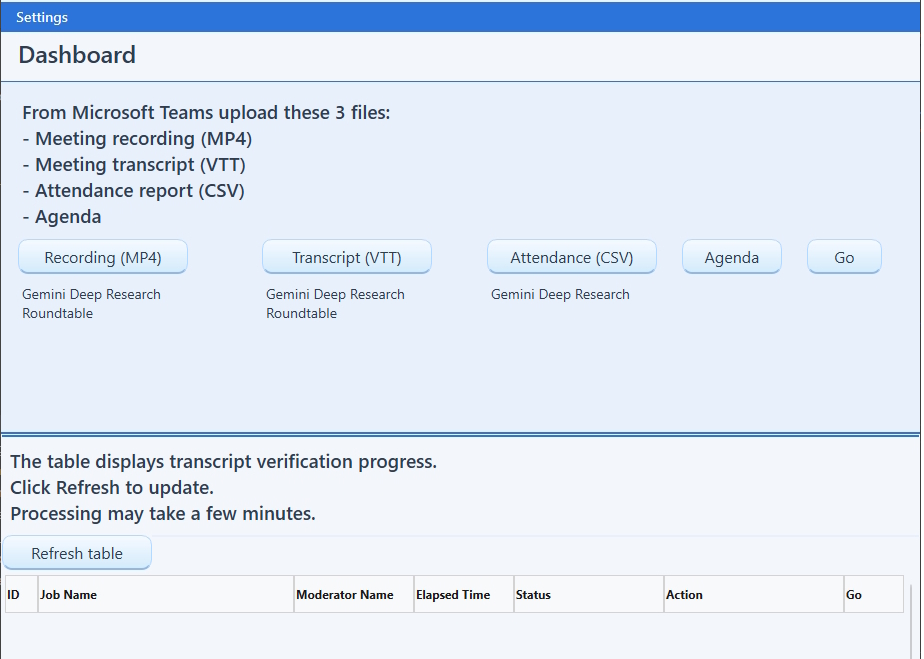
: Importing Microsoft Teams video vtt and csv and agenda files
The Microsoft Teams Transcript
The transcript is the primary working document throughout the verification process.
It contains:
-
recognised speech
-
speaker information (where available)
-
timestamps
-
chronological sequence of the discussion
The transcript becomes the foundation upon which AI analysis, participant review, moderator verification, and Minutes of Meeting generation are built.
Although the transcript forms the centre of the workflow, it should not be regarded as the sole source of truth.
Instead, it represents the first interpretation of the meeting, generated automatically by speech recognition technology.
The purpose of AI-Transcript is to progressively verify and improve that interpretation.
The Meeting Recording
While the transcript provides recognised text, the meeting recording preserves the original conversation exactly as it occurred.
It is the authoritative evidence against which transcript content can be verified.
Whenever uncertainty exists, moderators can return to the original recording to determine:
-
whether words were recognised correctly
-
whether speaker identification is accurate
-
whether the tone or intent has been misunderstood
-
whether overlapping speech affected transcription quality
-
whether important information has been omitted
Unlike traditional transcript review systems, AI-Transcript integrates audio playback directly into the verification process.
Moderators do not need to manually search through an hour-long recording to locate a specific discussion.
Relevant audio excerpts are immediately available alongside the transcript, significantly reducing the time required to verify complex conversations.
Attendance Report
Meetings frequently contain participants with similar voices or incomplete speaker identification.
The Microsoft Teams attendance report provides valuable supplementary information, including:
-
participant names
-
attendance duration
-
meeting join and leave times
This information assists the moderator when confirming speaker identities.
Correct speaker identification is particularly important because decisions and action items become associated with individual participants.
An incorrectly identified speaker may result in an action being assigned to the wrong person, potentially affecting project delivery and accountability.
The Meeting Agenda
The meeting agenda is one of the most valuable yet frequently overlooked sources of contextual information.
Many organisations already prepare agendas before important meetings.
Unfortunately, once the meeting concludes, these documents are often ignored during transcript analysis.
AI-Transcript treats the agenda as an important source of business context.
An agenda typically contains:
-
discussion topics
-
project names
-
customer names
-
technical terminology
-
expected decisions
-
planned objectives
By analysing the agenda before reviewing the transcript, AI develops a better understanding of the meeting's intended subject matter.
For example, if the agenda refers to Project Orion, AI is significantly less likely to misinterpret that name as similar-sounding everyday language.
Similarly, if the agenda contains specialised engineering terminology, product names, or organisational acronyms, AI gains valuable contextual information before transcript verification begins.
The agenda therefore improves understanding without altering the transcript itself.
Supporting Documents
Many meetings involve supporting material such as:
-
project proposals
-
technical specifications
-
policy documents
-
contracts
-
reports
-
presentations
-
design documents
AI-Transcript allows these documents to be imported alongside the transcript.
These documents provide additional business context that enables AI to recognise terminology, understand references made during discussion, and interpret statements more accurately.
For example, participants may repeatedly refer to:
"Option Three"
Without supporting documentation, AI cannot determine what "Option Three" represents.
When the relevant proposal or presentation is available, AI can understand the discussion with considerably greater accuracy.
Company Terminology
Every organisation develops its own language.
Internal project names.
Product codes.
Department abbreviations.
Customer identifiers.
Technical jargon.
Industry-specific terminology.
Although these terms are perfectly understandable to employees, they frequently challenge speech recognition systems.
Consequently, unusual terminology may be transcribed inconsistently throughout a meeting.
AI-Transcript identifies these terms early in the verification process and presents them for confirmation.
Once verified, consistent terminology is maintained throughout the transcript.
This improves readability while also increasing the accuracy of subsequent AI analysis.
Why More Context Produces Better AI
Artificial Intelligence does not think like a human.
Instead, it predicts meaning from available information.
The more contextual information AI receives, the better those predictions become.
Consider the sentence:
"We'll proceed with Phoenix."
Without context, Phoenix could refer to:
-
a software product
-
a customer
-
a project
-
a city
-
a company
-
a code name
If the meeting agenda clearly identifies Phoenix as the name of a migration project, AI immediately understands the intended meaning.
Providing additional context reduces ambiguity before it becomes a problem.
Creating a Verification Project
Once all available evidence has been imported, AI-Transcript creates a single verification project.
Rather than treating each file independently, the system links all evidence together into one coherent meeting record.
This project becomes the working environment for the remainder of the verification process.
Every participant reviews the same transcript.
Every comment relates to the same evidence.
Every moderator decision remains traceable to the original meeting recording.
This integrated approach ensures consistency throughout the entire verification lifecycle.
Preserving the Original Evidence
An important principle of the AI-Transcript methodology is that original evidence is never replaced.
The imported transcript remains preserved.
The original meeting recording remains unchanged.
Attendance reports remain intact.
Supporting documents remain available.
Verification does not overwrite evidence.
Instead, it builds upon it.
Corrections, annotations, participant comments, moderator decisions, and AI observations become additional layers of information associated with the original meeting.
This approach preserves complete traceability and supports future review or audit if required.
A Strong Foundation for Verification
The acquisition phase may appear straightforward, yet it is one of the most important stages of the entire methodology.
Every subsequent phase depends upon the quality and completeness of the evidence collected at the beginning of the process.
Missing recordings reduce verification capability.
Missing agendas reduce contextual understanding.
Missing attendance reports complicate speaker identification.
Conversely, comprehensive meeting evidence allows Artificial Intelligence and human reviewers to work from a common, well-informed understanding of the meeting.
Verification therefore begins long before anyone reviews the transcript.
It begins with collecting the right evidence.
Conclusion
The objective of the acquisition phase is not simply to upload files.
It is to establish a complete and trustworthy foundation for transcript verification.
By combining transcripts, recordings, attendance information, agendas, supporting documentation, and organisational terminology into a single verification project, AI-Transcript ensures that every later decision is based on the richest possible understanding of the meeting.
With the evidence now assembled, the methodology moves to its next stage: AI Transcript Analysis, where Artificial Intelligence performs the initial quality review and identifies issues that may affect the reliability of the final Minutes of Meeting.