Chapter 6 - Phase 2 AI Transcript Analysis
Artificial Intelligence as the First Reviewer
Once the meeting evidence has been collected, AI-Transcript begins the first stage of transcript verification.
This stage is intentionally different from most AI meeting applications.
Many meeting solutions immediately attempt to produce a meeting summary or draft Minutes of Meeting from the raw transcript. While this approach is fast, it assumes that the transcript is already complete, accurate, and ready for interpretation.
AI-Transcript takes a different approach.
Instead of immediately generating Minutes of Meeting, Artificial Intelligence first asks a more important question:
"Can this transcript be trusted?"
Only after that question has been answered does the system proceed towards creating the final meeting record.
This philosophy changes the role of Artificial Intelligence from a document generator into an intelligent quality assurance analyst.
Analysing Before Summarising
The objective of AI Transcript Analysis is not to rewrite the meeting.
Its purpose is to identify anything that may prevent the creation of accurate Minutes of Meeting.
Artificial Intelligence examines the transcript much like an experienced meeting facilitator would.
It looks for:
-
inconsistencies
-
ambiguity
-
missing information
-
possible transcription errors
-
incomplete decisions
-
missing responsibilities
-
unclear action items
-
technical terminology
-
contextual problems
Rather than making changes automatically, AI prepares a structured review for the moderator and meeting participants.
Human judgement always remains central to the verification process.
A Professional Transcript Quality Analyst
AI-Transcript instructs the Large Language Model to adopt the role of a professional transcript quality analyst rather than a meeting summariser.
Instead of asking:
"Please summarise this meeting."
the system asks questions such as:
-
Are any statements incomplete?
-
Is the speaker identification reliable?
-
Are decisions clearly expressed?
-
Are action owners identified?
-
Are deadlines specified?
-
Does any discussion require clarification?
-
Are technical terms used consistently?
-
Are there conflicting statements?
-
Is additional context required?
This subtle difference significantly improves the quality of later AI-generated Minutes of Meeting because problems are identified before summarisation begins.
Looking Beyond Grammar
Traditional grammar correction tools focus on spelling, punctuation, and sentence structure.
AI-Transcript goes considerably further.
It examines whether the transcript accurately represents the business discussion.
For example, the following sentence may be grammatically correct:
"We'll finish that next month."
However, from a governance perspective the statement raises several questions:
-
Who will finish it?
-
Which task?
-
Which month?
-
Was this a commitment or merely a suggestion?
Although grammatically correct, the statement lacks sufficient information to become an action item.
AI therefore identifies it as requiring clarification.
Categories of AI Findings
During analysis, AI organises potential issues into structured categories.
These categories later become the basis of participant collaboration and moderator review.
The principal categories include:
Transcript Blockers
Issues that prevent reliable Minutes of Meeting from being created.
Examples include:
-
missing decisions
-
missing owners
-
missing deadlines
-
conflicting statements
-
unknown speakers
-
significant transcription errors
These issues require attention before the transcript can be considered complete.
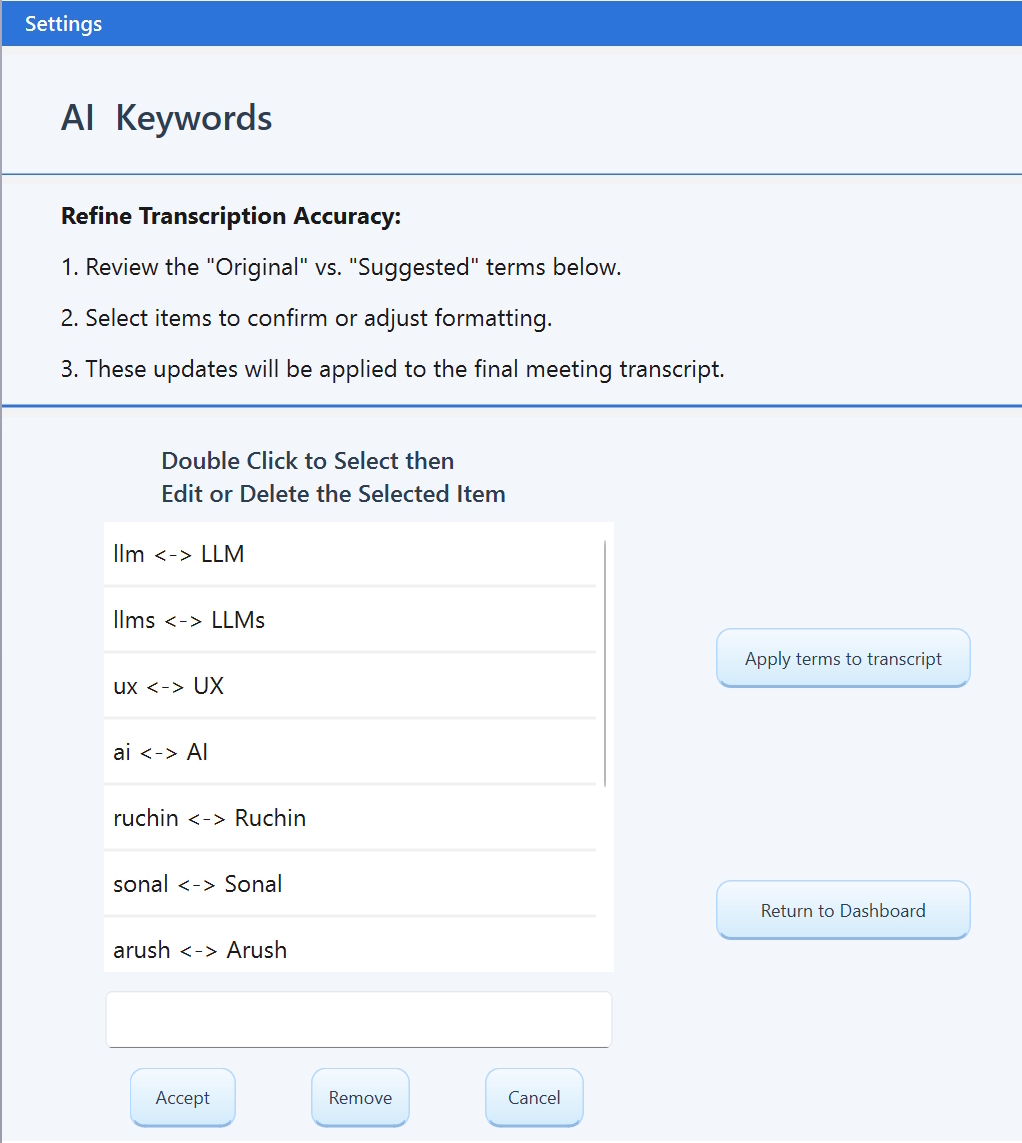
Figure 2: Keywords found by AI and suggested correct spelling
Corrections
Objective errors within the transcript.
These may include:
-
incorrect speaker names
-
misheard words
-
incorrect numbers
-
duplicated text
-
incorrect terminology
Corrections improve factual accuracy without changing the meaning of the meeting.
Clarifications
Statements that require additional explanation before they can be interpreted correctly.
Examples include:
-
ambiguous wording
-
missing context
-
undefined acronyms
-
incomplete statements
-
unclear references
Clarifications improve understanding rather than correcting mistakes.
Suggestions
Recommendations intended to improve the usefulness of the final Minutes of Meeting.
Examples include:
-
extracting action items
-
identifying decisions
-
highlighting risks
-
identifying key discussion points
-
recommending transcript restructuring
Suggestions enhance the value of the transcript without altering historical evidence.
AI Identifies — Humans Decide
An important principle of AI-Transcript is that Artificial Intelligence does not determine the official meeting record.
AI identifies observations.
Humans make decisions.
For example, AI may report:
"This statement appears to contain a decision."
The moderator determines whether that observation is correct.
Similarly, AI may identify:
"Action owner appears to be missing."
Meeting participants may later clarify who accepted responsibility.
The moderator then decides whether and how the transcript should be updated.
This approach prevents AI from introducing unsupported assumptions into official meeting records.
Confidence Rather Than Certainty
Artificial Intelligence rarely operates with absolute certainty.
Instead, it evaluates probabilities based upon available information.
AI-Transcript therefore treats AI findings as recommendations for review, not as unquestionable facts.
Some issues are immediately obvious.
Others require human interpretation.
For example:
An incorrectly recognised product name may be confidently identified as an error.
Whether a participant actually committed to performing a task may require discussion among those who attended the meeting.
Recognising this distinction helps maintain confidence in the verification process.
AI as an Intelligent Assistant
Throughout the analysis stage, Artificial Intelligence performs the repetitive work that would otherwise consume significant moderator time.
Instead of reading an entire transcript searching for possible issues, moderators receive a prioritised list of observations.
This dramatically improves efficiency.
Rather than reviewing every sentence equally, attention is focused where it is genuinely required.
Artificial Intelligence therefore becomes an assistant that enhances human productivity rather than replacing human judgement.
Preparing for Collaboration
Once analysis is complete, AI-Transcript creates a structured verification project.
Each identified issue becomes linked to its corresponding transcript segment.
Participants and moderators no longer need to search manually through hundreds or thousands of transcript entries.
Instead, every observation is presented together with:
-
the transcript excerpt
-
speaker information
-
surrounding context
-
playback controls
-
issue category
This organisation transforms transcript review from an unstructured reading exercise into a focused verification workflow.
Background Processing
The analysis performed by AI is computationally intensive and may require several minutes depending on:
-
meeting duration
-
transcript size
-
number of participants
-
supporting documents
-
complexity of discussion
For this reason, AI-Transcript performs transcript analysis as a background process.
Users are not required to remain connected while processing occurs.
Once analysis has completed, users receive notification that the verification project is ready for review.
This approach allows organisations to analyse lengthy meetings without interrupting normal work.
Why This Stage Matters
At first glance, AI Transcript Analysis may appear to be an optional convenience.
In reality, it is one of the most important stages of the methodology.
Without intelligent pre-analysis:
-
moderators would manually inspect every transcript line,
-
participants would spend time searching for issues,
-
important ambiguities could remain unnoticed,
-
significant decisions might be overlooked.
AI dramatically reduces this effort by directing human attention precisely where it is needed.
Instead of replacing people, AI helps people spend their time more effectively.
The Foundation for Human Verification
Artificial Intelligence is exceptionally effective at identifying where uncertainty may exist.
Humans are exceptionally effective at resolving that uncertainty.
The AI analysis stage bridges these complementary strengths.
It provides the roadmap for every subsequent phase of transcript verification.
Participants know which discussions require attention.
Moderators understand where evidence should be reviewed.
The verification process becomes organised, consistent, and repeatable.
Only after this preparation does the methodology move to the next stage:
Speaker Verification and Organisational Terminology, where the transcript begins its transformation from an automatically generated document into a trusted organisational record.
Conclusion
The purpose of AI Transcript Analysis is not to replace human judgement.
Its purpose is to ensure that human expertise is applied where it has the greatest value.
By identifying potential issues before collaborative review begins, Artificial Intelligence significantly improves both the efficiency and the quality of transcript verification.
The result is a verification process that combines computational speed with human understanding, laying the foundation for accurate, trustworthy Minutes of Meeting.
**