Chapter 8 - Phase 4 Participant Collaboration
Human Knowledge Completes Artificial Intelligence
Artificial Intelligence has transformed the way organisations record meetings.
It can recognise speech, identify speakers, summarise discussions, and even generate Minutes of Meeting within seconds.
Yet Artificial Intelligence has one important limitation.
It was not present during the meeting.
It cannot know:
-
what participants were thinking,
-
whether a statement was sarcastic,
-
which proposal everyone eventually accepted,
-
whether a technical term was used incorrectly,
-
whether a participant intended to make a commitment,
-
or whether everyone understood a decision in the same way.
Only the people who participated in the meeting possess this knowledge.
For this reason, AI-Transcript does not consider transcript verification to be the responsibility of Artificial Intelligence alone.
It is a collaborative process.
Artificial Intelligence identifies potential issues.
Meeting participants contribute their knowledge.
The moderator evaluates all evidence before approving the official transcript.
This combination creates a level of confidence that neither AI nor humans could achieve independently.
Why Participants Matter
Every meeting participant experiences the meeting from a different perspective.
A project manager focuses on delivery.
An engineer concentrates on technical discussions.
A finance representative listens for budgets and approvals.
A customer representative pays attention to commitments and expectations.
Although everyone attended the same meeting, each participant remembers different details.
Collectively, these perspectives create a far more complete understanding of the discussion than any single individual—or any AI model—could produce.
AI-Transcript harnesses this collective knowledge through a structured review process.
From Passive Readers to Active Contributors
In traditional meeting workflows, participants receive the Minutes of Meeting after they have already been written.
Their role is limited to reading the document and sending corrections by email.
This approach creates several problems.
Corrections become fragmented.
Different versions begin circulating.
Comments are easily overlooked.
The author must manually consolidate feedback.
There is rarely any clear record explaining why changes were made.
AI-Transcript replaces this unstructured process with collaborative verification.
Participants review the transcript itself rather than the finished Minutes of Meeting.
This allows issues to be resolved before meeting minutes are generated.
The result is a cleaner, more accurate, and more transparent workflow.
Reviewing the Transcript, Not the Minutes
This distinction is fundamental to the AI-Transcript methodology.
Participants are not reviewing the Minutes of Meeting.
They are reviewing the evidence from which those minutes will be created.
By improving the transcript first, every downstream AI-generated document benefits automatically.
These include:
-
Minutes of Meeting
-
Executive Summaries
-
Decision Registers
-
Action Lists
-
Project Reports
-
Knowledge Base Entries
One verified transcript supports many reliable outputs.
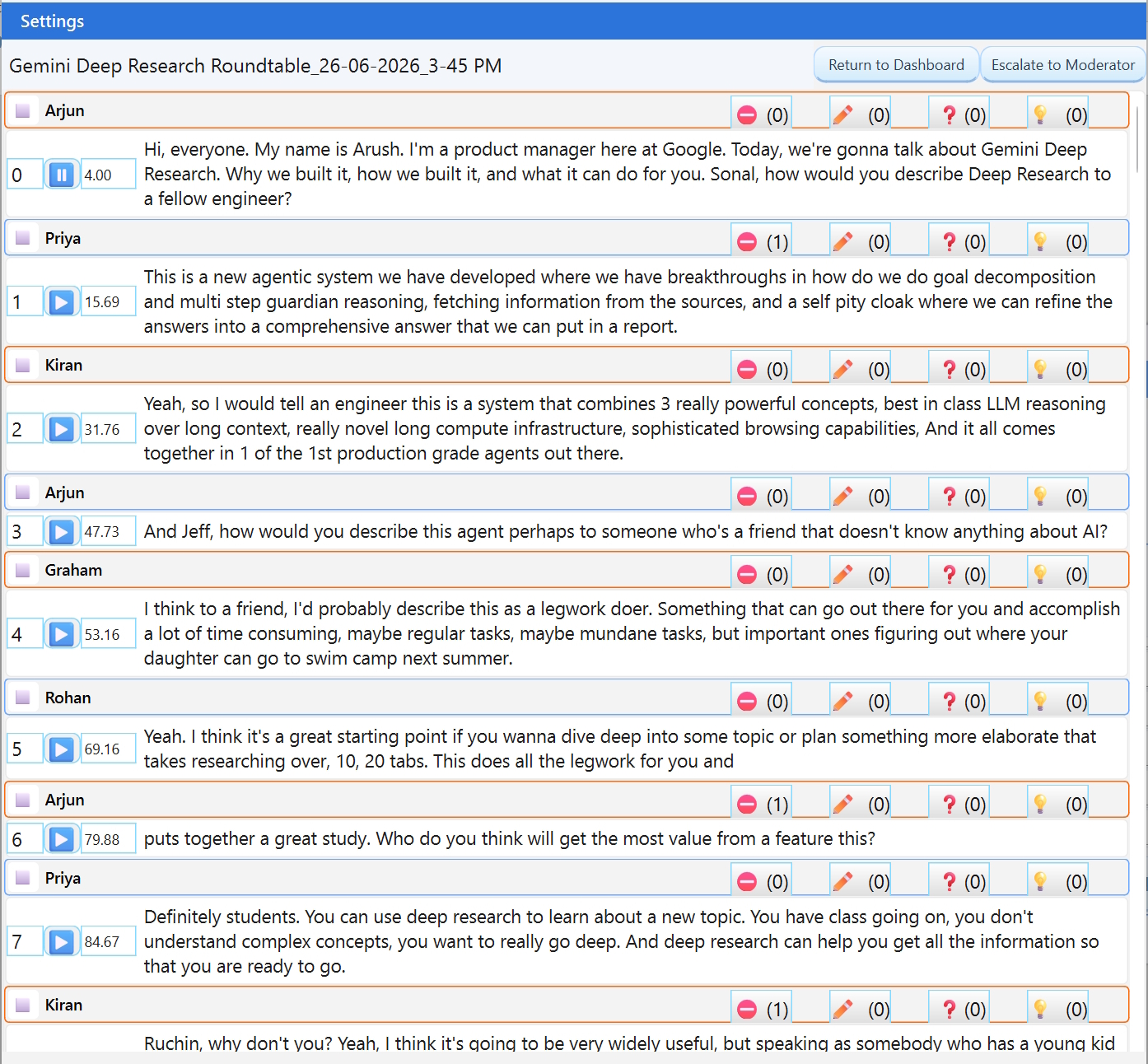
Figure 4: Screenshot of the AI-Transcript review screen, demonstrating how meeting participants compare written transcript text with its corresponding audio segment
A Structured Review Process
Rather than allowing unrestricted editing, AI-Transcript provides participants with a structured framework for submitting observations.
Every comment relates to a specific transcript segment.
Every observation is categorised.
Every contribution becomes traceable.
This structure ensures that comments remain organised, searchable, and easy for moderators to evaluate.
Instead of asking participants:
"Please review the transcript."
AI-Transcript asks much more focused questions.
For example:
-
Is this statement correct?
-
Does this decision require clarification?
-
Is the speaker correctly identified?
-
Is important context missing?
-
Should this discussion produce an action item?
Focused questions produce focused answers.
Four Types of Participant Feedback
AI-Transcript organises participant observations into four clearly defined categories.
This ensures that moderators immediately understand the purpose of each comment.
1. Transcript Blockers â›”
Blockers identify issues that prevent reliable Minutes of Meeting from being created.
These are the highest-priority observations.
Typical examples include:
-
incorrect transcription
-
unknown speaker
-
missing decision
-
missing action owner
-
missing deadline
-
conflicting statements
A blocker indicates that an important part of the meeting cannot yet be interpreted with confidence.
These issues should normally be resolved before transcript approval.
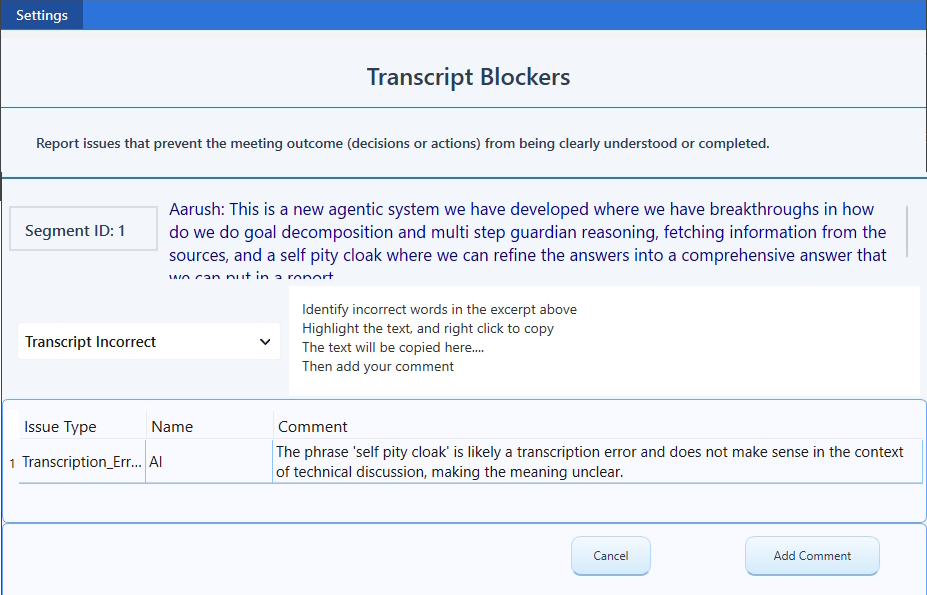
Figure 5: Blockers identify issues that prevent reliable Minutes of Meeting from being created
2. Corrections âœï¸
Corrections identify objective transcription errors.
Typical examples include:
-
incorrect words
-
incorrect names
-
incorrect numbers
-
duplicated content
-
incorrect speaker assignment
Corrections improve factual accuracy without changing the meaning of the meeting.
They answer the question:
"What was actually said?"
3. Clarifications â“
Clarifications provide additional understanding where the transcript alone may be insufficient.
Examples include:
-
ambiguous wording
-
missing business context
-
undefined acronyms
-
unclear references
-
incomplete explanations
Clarifications answer a different question:
"What did the participants mean?"
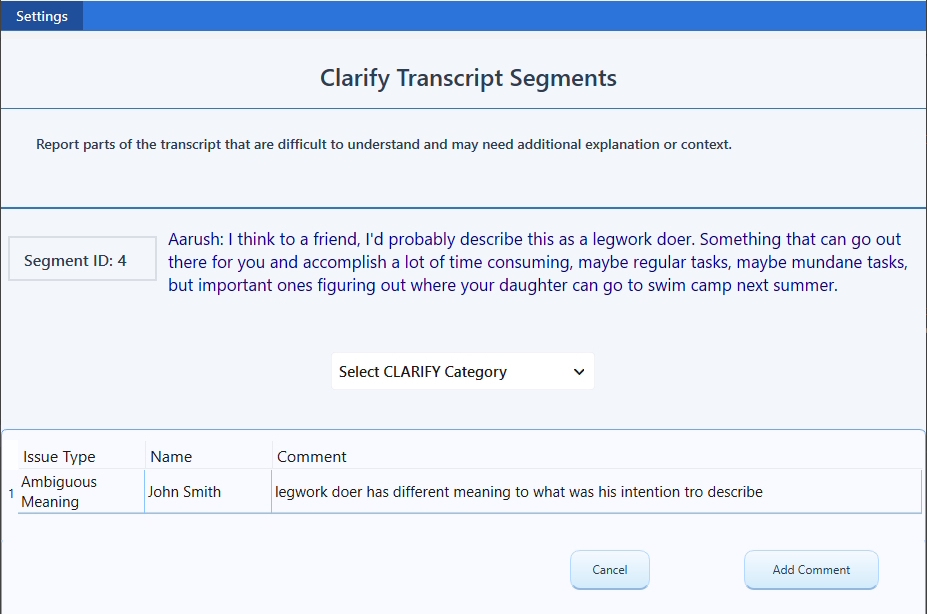
Figure 6: Clarifications provide additional understanding where the transcript alone may be insufficient.
4. Suggestions 💡
Suggestions improve the usefulness of the final meeting record.
Examples include:
-
identify an overlooked decision
-
extract an action item
-
highlight an important risk
-
merge related discussion
-
split unrelated topics
Suggestions do not necessarily indicate errors.
Instead, they enhance the quality of future AI-generated outputs.
Comments Are Not Transcript Changes
One of the most important principles of AI-Transcript is that participant comments never modify the transcript directly.
This protects the integrity of the original meeting record.
Participants contribute observations.
The moderator determines whether those observations should result in:
-
a transcript correction,
-
an annotation,
-
additional clarification,
-
or no change at all.
This distinction preserves accountability while encouraging open participation.
Every Comment Has an Author
Each participant comment is permanently associated with the person who submitted it.
This provides several important benefits.
Transparency.
Accountability.
Traceability.
If the moderator requires additional information, the contributor can be contacted directly.
Future reviewers can also understand why particular changes were proposed.
The verification process therefore becomes fully auditable.
Encouraging Constructive Collaboration
The objective of participant review is not to criticise the transcript.
Nor is it to criticise Artificial Intelligence.
Instead, participants are invited to improve the quality of the meeting record through collaborative knowledge sharing.
For this reason, AI-Transcript encourages reviewers to focus on:
-
facts rather than opinions,
-
clarification rather than criticism,
-
evidence rather than assumptions.
This creates a positive review culture in which participants collectively improve the quality of organisational knowledge.
A Practical Example
Consider the following transcript excerpt.
John: "We'll complete the migration before the customer audit."
A project engineer submits a clarification:
"The customer audit refers to the ISO 27001 compliance review scheduled for 14 September."
A project manager adds a suggestion:
"Create an action item assigning the migration to the Infrastructure Team."
A business analyst reports a correction:
"Migration should be 'database migration', not 'server migration'."
None of these comments modifies the transcript immediately.
Instead, they provide the moderator with additional evidence for making an informed decision.
When combined, these contributions create a significantly richer and more accurate meeting record than AI alone could produce.
Collaboration Improves Artificial Intelligence
An often-overlooked benefit of participant collaboration is that it improves future AI analysis.
Each verified correction contributes to:
-
more consistent terminology,
-
better understanding of organisational language,
-
improved project references,
-
clearer decision structures,
-
more reliable action extraction.
Over time, the organisation develops increasingly accurate verified meeting data.
Artificial Intelligence benefits because it analyses better information.
The organisation benefits because its knowledge base becomes progressively more reliable.
Shared Responsibility
Creating trustworthy Minutes of Meeting should never be the responsibility of one individual.
AI identifies potential issues.
Participants contribute their expertise.
Moderators evaluate the evidence.
Together they establish the official meeting record.
This distribution of responsibility significantly reduces the likelihood that important information will be overlooked.
It also builds confidence among participants because everyone has had an opportunity to contribute before the transcript is approved.
Collaboration Builds Trust
Trust is rarely achieved through automation alone.
People trust information when they know:
-
it has been reviewed,
-
multiple perspectives have been considered,
-
disagreements have been resolved,
-
evidence remains available,
-
decisions are transparent.
Participant collaboration transforms transcript verification from an individual task into a governed organisational process.
The transcript no longer represents the opinion of one person—or one AI model.
It represents the collective understanding of the meeting participants, validated by a moderator and supported by the original meeting recording.
Conclusion
Participant collaboration is one of the defining characteristics of the AI-Transcript methodology.
Rather than treating attendees as passive recipients of meeting minutes, AI-Transcript recognises them as valuable contributors to the quality of the organisational record.
By providing structured, traceable, and evidence-based collaboration, the platform captures knowledge that Artificial Intelligence alone cannot infer.
The result is a transcript that reflects not only the words spoken during the meeting, but the shared understanding of the people who were there.
With participant review complete, the verification process moves to its most important stage: Moderator Review and Transcript Verification, where all AI findings and participant contributions are evaluated to produce the organisation's official, verified meeting record.